


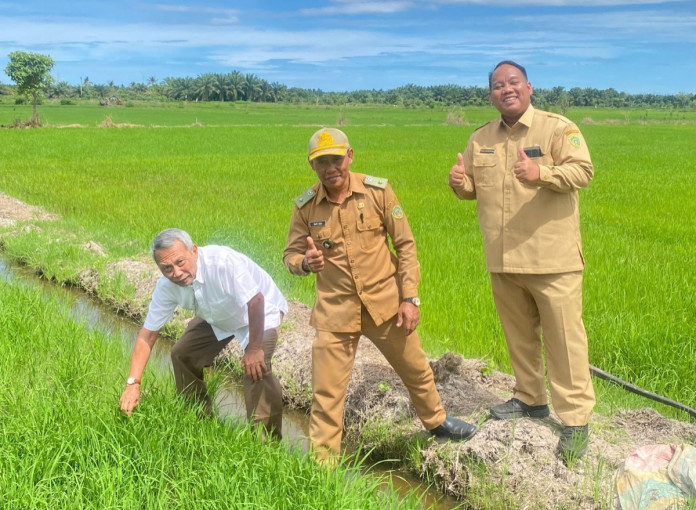
Amid the challenges of climate change and the need to strengthen national food security, adaptive rice varieties are increasingly viewed as an important solution for Indonesia’s agricultural sector. One such innovation is Gamagora 7, a rice variety capable of growing in both irrigated paddy fields and rainfed agricultural land. This potential has encouraged Universitas Gadjah Mada (UGM), the East Kalimantan chapter of the UGM Alumni Family (KAGAMA), and the Penajam Paser Utara Regency Government to conduct a field trial of Gamagora 7 rice.
Professor Taryono, a professor at UGM’s Faculty of Agriculture (Agriculture UGM) and the innovator behind the development of Gamagora 7, explained that the variety was developed to address agricultural challenges in rainfed areas through high productivity, resistance to pests and diseases, and improved nutritional content.
According to him, Gamagora 7 was initially developed as an early-maturing, high-yield rice variety, but research revealed additional advantages, including ultra-early maturity and high nutritional value.
“Gamagora 7 offers high productivity, a short growing period, ultra-early maturity, and rich nutritional content,” he said on Saturday (May 30).
The development of Gamagora 7 required a lengthy process. Breeding efforts began in 2008, and the variety was officially released in 2023, after nearly two decades of work. In addition, before it could be officially released, the variety had to undergo testing at eight locations across Indonesia, including Sumatra, Java, Kalimantan, Sulawesi, Halmahera, and West Nusa Tenggara. Such an extensive development process required substantial investment.
“Developing a new variety requires significant funding, patience, and a long period of time,” he said.
The variety has a productivity potential of up to 9.7 tons of harvested dry grain per hectare and was specifically designed to adapt to rainfed farming conditions. Professor Taryono explained that among dozens of breeding lines developed by the UGM research team, only Gamagora 7 has so far received government approval for commercialization. Although it was officially released as a paddy rice variety, he noted that Gamagora 7 was actually introduced as a “rainfed rice” variety.
“Gamagora 7 met the requirements for release as a paddy rice variety because of its productivity and resilience,” he explained.
According to Professor Taryono, Gamagora 7 has significant potential to support Indonesia’s food self-sufficiency because the country possesses vast areas of rainfed agricultural land. However, the main challenges currently lie in the limited availability of seeds and insufficient funding support for the development of future varieties.
“I am optimistic that Gamagora 7 can contribute to national food self-sufficiency,” he said.
He expressed hope that UGM would provide greater support for leading research innovations that have demonstrated tangible impacts on society, including the development of future generations of Gamagora varieties beyond Gamagora 7.
According to him, plant breeding research requires sustained support in the form of facilities, land, and funding to ensure that agricultural innovations do not stall midway through development.
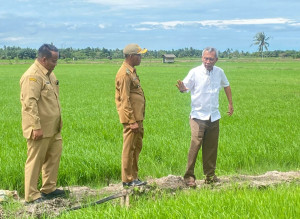
The Chair of KAGAMA East Kalimantan, Lalu Faudzul Idhi, stated that the Gamagora 7 rice trial in Penajam Paser Utara reflects KAGAMA’s commitment to connecting university research innovations with farmers’ real needs. In this context, KAGAMA serves as an “industry bridge” that tests whether innovations developed by UGM are feasible for practical implementation in the field.
“KAGAMA essentially serves as UGM’s industry arm, testing UGM products before they enter the downstream commercialization stage,” he explained.
Idhi said that East Kalimantan was selected because it faces complex agricultural challenges, ranging from unpredictable tropical climate patterns to nutrient-poor soil conditions. These characteristics, he noted, make the region an ideal location for testing Gamagora 7’s adaptability, which is claimed to thrive in both wetland and rainfed environments.
“Those climatic conditions are exactly what motivated us to test whether Gamagora 7 can be successfully cultivated here,” he said.
In implementing the trial, Idhi explained that KAGAMA East Kalimantan has provided direct assistance to farmers through educational activities and field demonstrations. Farmers were then asked to cultivate the variety under two different land conditions to verify its resilience to climate variability, pest attacks, and harvest productivity as claimed by the research.
In addition, the Village Innovation School program in Penajam Paser Utara, developed in collaboration with UGM, has become an important driver of agricultural innovation in the region.
He explained that the planting was carried out on a one-hectare plot divided into two sections: one half was planted on a wetland and the other on rainfed land. The objective was to test Gamagora 7’s claim as an “amphibious” rice variety capable of growing in both environments.
“That is why we assisted with the one-hectare trial, dividing it between two different land conditions. We have tested it, and the plants have already begun to grow,” he explained.
The trial results will provide valuable feedback for UGM to continue evaluating and refining the development of Gamagora 7 before expanding cultivation to other areas in East Kalimantan, including Kutai Kartanegara and East Kutai.
If the trial produces optimal results, the collaborative model involving universities, alumni, local governments, and farmers is expected to be replicated in other regions as part of broader efforts to strengthen national food security.
“We certainly hope this trial succeeds so that it can later be expanded to other areas across East Kalimantan,” Idhi concluded.
Author: Cyntia Noviana
Editor: Gusti Grehenson
Post-Editor: Zabrina Kumara
Photo: KAGAMA East Kalimantan