


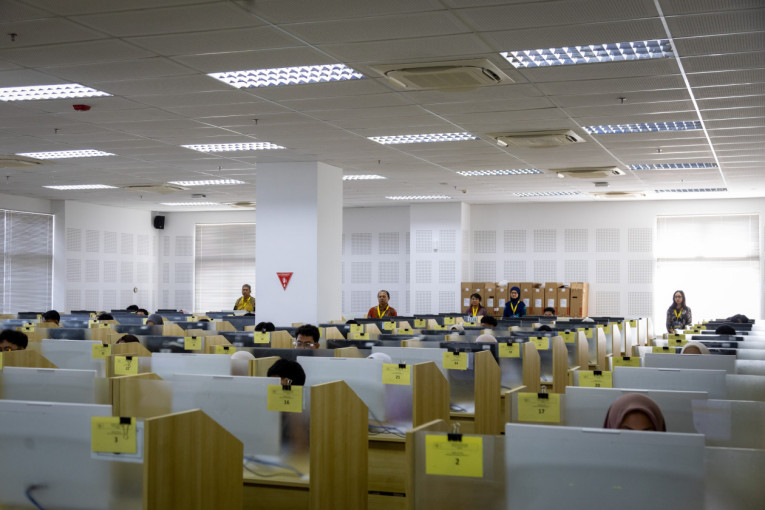
The 2026 Universitas Gadjah Mada Computer-Based Admission Test (UM UGM CBT) represents one of the university’s largest-scale applications of information technology operations. A total of 44,972 applicants are participating in the examination, which takes place from Jun 2 to 8, 2026, in Yogyakarta and Jakarta.
The large number of participants requires a system that can operate reliably throughout the examination period. Various information technology components have been prepared to ensure that all participants can complete the test without significant disruptions. These preparations include computing infrastructure, network systems, cybersecurity measures, and risk mitigation mechanisms designed well before the examination began.
Director of UGM’s Directorate of Information Technology (DTI), Professor Ridi Ferdiana, explained that this year’s UM UGM CBT uses infrastructure distributed across two examination locations: Yogyakarta and Jakarta. To support these needs, UGM has deployed a high-performance server cluster supported by a managed cloud architecture. All servers are also equipped with backup systems to ensure service availability throughout the examination period.
In addition, the thousands of computers used by participants have undergone standardization, inspection, and security checks before deployment.
“The implementation of UM UGM CBT involving nearly 45,000 participants is one of the largest information technology operations we have conducted within the academic environment,” he said on Friday (Jun. 5).
According to Professor Ridi, system stability is a critical factor for an examination conducted over several days with two sessions each day. To maintain smooth operations, the examination network has been separated from the university’s public internet network to prevent other digital activities from affecting test administration.
UGM has also prepared multiple internet service providers as backups in the event of connectivity disruptions. Each examination site is equipped with backup power supplies, including uninterruptible power supply (UPS) systems and generators, to handle electrical outages.
“We ensure that the examination system has multiple layers of redundancy so that it can continue operating even if one supporting component experiences a disruption,” he explained.
In addition to maintaining system stability, UGM has strengthened security measures to prevent various forms of cheating during the examination. Test questions are stored in a secure system and can only be accessed when an examination session begins.
Participants’ computers are also specially configured so they cannot be used to open other applications or access information sources outside the examination system. These measures are complemented by multiple layers of participant screening before entering examination rooms.
“We designed system security comprehensively, from data protection to its integration with on-site monitoring procedures,” said Professor Ridi.
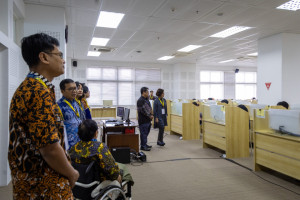
The rapid development of digital technology has also become a major consideration in this year’s UM UGM CBT administration. According to Professor Ridi, the challenge is no longer limited to conventional cheating practices but also includes the use of micro-devices connected to artificial intelligence technologies.
Devices such as smart glasses, hidden cameras, and miniature communication tools may potentially be used to obtain answers from outside the examination room. Therefore, UGM has intensified inspections of personal belongings and electronic accessories carried by participants before they enter the examination venue.
“Technological developments such as generative AI present new challenges that we must anticipate through a combination of technological safeguards and stricter supervision,” he said.
Professor Ridi added that several system improvements have been implemented based on evaluations of previous UTBK SNBT and UM UGM CBT examinations. One example is the development of a more dynamic token system to reduce potential queues for access when examinations begin.
The information technology team has also prepared a monitoring dashboard that enables real-time monitoring of participants’ computers from a central control center. Through this system, potential disruptions and anomalies can be detected and addressed more quickly.
“We continue learning from previous implementations so that the system becomes increasingly reliable and responsive to various situations in the field,” he said.
In addition to network disruptions and cybersecurity concerns, UGM has also prepared special procedures to anticipate possible power outages. Although examination sites are supported by premium electricity services and backup generators, contingency plans have been developed to ensure that participants’ rights are protected in the event of disruptions.
Under certain circumstances, the system is equipped with a time-compensation mechanism adjusted to the duration of any interruption. This measure is intended to uphold fairness throughout the selection process.
“The most important thing is ensuring that all participants have the same opportunity to complete the examination within the appropriate amount of time,” he concluded.
Author: Triya Andriyani
Post-editor: Rajendra Arya
Photo: Donnie