


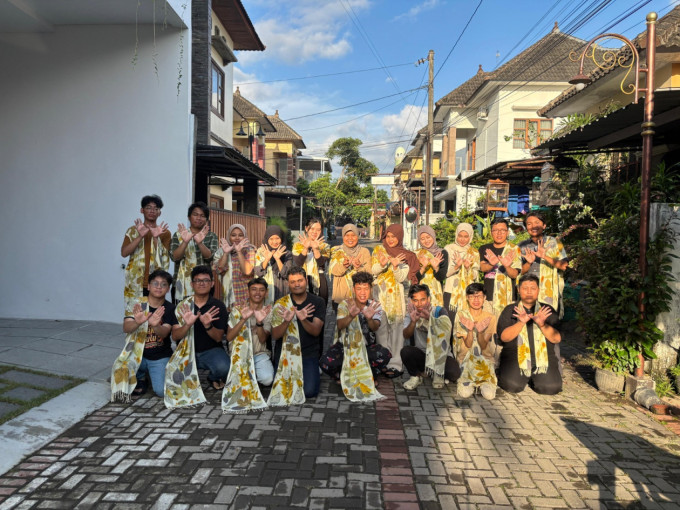
Ahead of their community service deployment in mid-June, the Pelita Nusantara Team of Universitas Gadjah Mada Community Service and Empowerment Learning Program (KKN-PPM UGM) organized an educational workshop on ecoprint production in Sidoarum Village, Sleman Regency, Yogyakarta Special Region, on Sunday (May 24). The activity was attended by 18 members of the Pelita Nusantara Team from various subunits and featured speakers from the Yogyakarta chapter of the Indonesian Eco-Printer Association (AEPI).
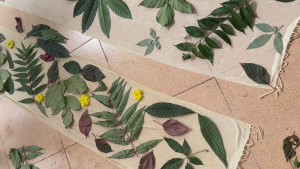
The workshop focused on providing introductory material on using environmentally friendly materials, such as leaves, in fashion production. Participants learned an ecoprinting technique that uses plant-derived dyes applied to media such as fabric or bark cloth to create distinctive patterns and colors. During the workshop, participants worked with 1.5-meter pieces of fabric dyed using leaves and flowers.
Annisa Attaya Zahra, a member of the Pelita Nusantara Team from the Department of Sociology, explained that the ecoprint training will later be offered to members of the Family Welfare Empowerment (PKK) organization as part of a women’s empowerment initiative in Bukit Raya Village, Penajam Paser Utara Regency, East Borneo.
“Bukit Raya Village has many women’s community groups, including PKK organizations. I began thinking about what kind of product these groups could create that would also have economic value, and ecoprint emerged as the answer,” said Annisa on Monday (Jun. 8).
In addition to supporting women’s empowerment, she chose ecoprint to promote a new model of environmentally friendly fashion, often referred to as slow fashion. She explained that ecoprint products are not merely fashion fabrics but also an environmentally sustainable movement.
“This is not just fabric for fashion. It is also an effort to protect the environment, as clothing production contributes significantly to pollution. One way to address this issue is through slow fashion, and ecoprint is one of its products,” Annisa said.
The Leader of the Pelita Nusantara Team, Christian Perdana Putra Malau, explained that involving members from different subunits in the workshop was intended to introduce ecoprint more broadly. According to him, the technique has the potential to be developed both at KKN locations and in the participants’ home communities.
“We hope ecoprint will not only be known within the Bukit Raya subunit. And also when team members return to their hometowns, they can introduce ecoprint there as well, since the process is relatively simple and produces aesthetically appealing results,” said Christian.
Christian further noted that the fabrics produced during the training will later be sewn into team vests. According to him, this initiative represents a breakthrough and serves as a slow-fashion campaign by the Pelita Nusantara Team.
The workshop was led by Rahmi Ananta Widya Kristianti, affectionately known as Ami. A 1999 alumna of UGM’s Faculty of Forestry, she currently serves as an administrator of the Yogyakarta chapter of the Indonesian Eco-Printer Association (AEPI). Since 2020, Ami has studied and actively practiced ecoprinting. She believes the method is an innovative contribution to the fashion industry because it relies on environmentally friendly materials.
Ami said that her involvement as a trainer provided an opportunity to share knowledge about slow fashion. She added that the Pelita Nusantara Team’s efforts to introduce ecoprint go beyond environmental education and also aim to improve local economic opportunities.
“We want to introduce the concept of slow fashion because textile waste remains one of the largest contributors to environmental pollution. We hope the students can also help stimulate local micro, small, and medium enterprises because ecoprint products have considerable market value,” she said.
Ami hopes that knowledge of slow fashion can become part of a green lifestyle that supports environmental sustainability. She added that the Pelita Nusantara Team’s contribution could serve as a small but meaningful first step toward encouraging environmentally responsible lifestyles.
“Through ecoprint, we hope to foster collective awareness about the importance of environmental conservation. It begins with small actions, because small things make people better, even though perfection itself is never a small thing,” she concluded.
Contributor: Rajendra Arya
Author: Hanifah
Editor: Gusti Grehenson
Post-editor: Rajendra Arya
Photo: Pelita Nusantara KKN Team