


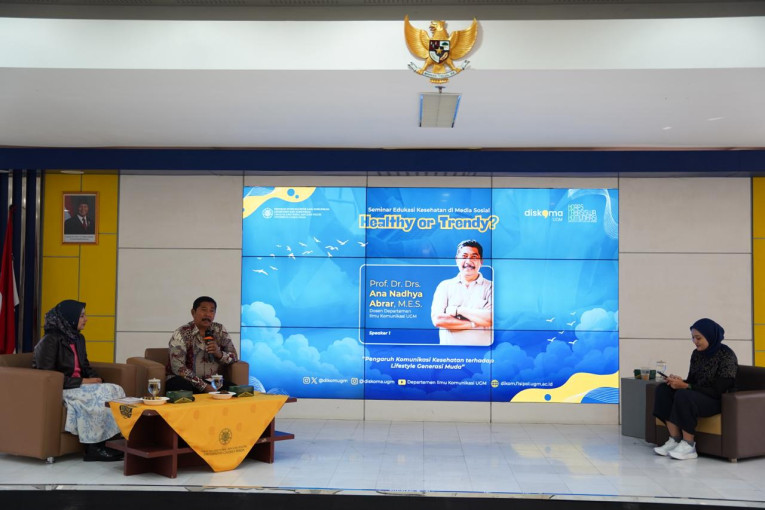
Amid today’s overwhelming flow of digital information, health and lifestyle trends are increasingly being shared and consumed by the public. Although such information spreads rapidly, not all of it is accurate or reliable, and some is outright misinformation. In this context, social media does not always play a positive role as a medium for disseminating information. This phenomenon is believed to have health implications for its users, most of whom are members of Generation Z.
From a communication science perspective, the excessive use of social media for information dissemination can lead to “sluggish thinking” and erode critical thinking skills. Lecturer at the Department of Communication Science, Universitas Gadjah Mada (UGM), Professor Ana Nadhya Abrar, explained that excessive social media use may actually prevent users from truly obtaining meaningful information.
“Social media can trap users in waves of information that reinforce biases. Social media algorithms determine content according to platform interests, create social polarization, and lead to digital dependency as well as the erosion of critical thinking,” she said during the public discussion titled “Edukasi Kesehatan di Media Sosial” (Health Education on Social Media) at the Fisipol UGM Auditorium on Saturday (Jun. 6).
Professor Abrar further explained that social media algorithms can control users and turn personal data into a commodity. She emphasized that social media platforms were essentially designed to allow large platforms to exert influence over users.
Therefore, she urged active social media users, particularly Gen Z, to maintain personal autonomy rather than surrender it to others, media outlets, or influencers. This underscores the importance of self-awareness and the ability to make healthy decisions independently.
“An intelligent person is someone who understands their own condition and knows whom to consult or where to seek treatment when they are ill. This reflects the importance of awareness of one’s own condition, including mental health,” she explained.

Physician and health influencer, Rianti Maharani, stated that health issues among younger generations are no longer caused by a lack of information, but rather by an excess of information that does not translate into behavioral change.
She described how social media shapes the health behavior of Generation Z, from algorithms that influence the content users see, to shifts in perception and beliefs that eventually lead to behavioral changes. However, Rianti also warned about the dangers of health hoaxes, false information, and non-credible influencers.
“The first step is to broaden people’s perspectives. Once perceptions begin to shift, behavioral changes can follow. However, disruptions in the process persist, including health misinformation. Hoaxes travel faster than the speed of light, and people tend to absorb them more quickly than accurate health information,” she said.
To prevent disease, Rianti emphasized the importance of adopting a “Small Habits Big Impact” approach to achieving a healthy lifestyle. She recommended making small but sustainable changes, such as getting enough sleep, walking for 10-30 minutes each day, drinking sufficient water, reducing screen time, and consuming raw foods. Through these efforts, she believes that small habits can gradually transform lives for the better.
“Start with things that are within our control. Small changes are more likely to be sustained than drastic changes,” she explained.
Author/Photo: Fatihah Salwa Rasyid
Editor: Gusti Grehenson
Post-editor: Jasmine Ferdian