


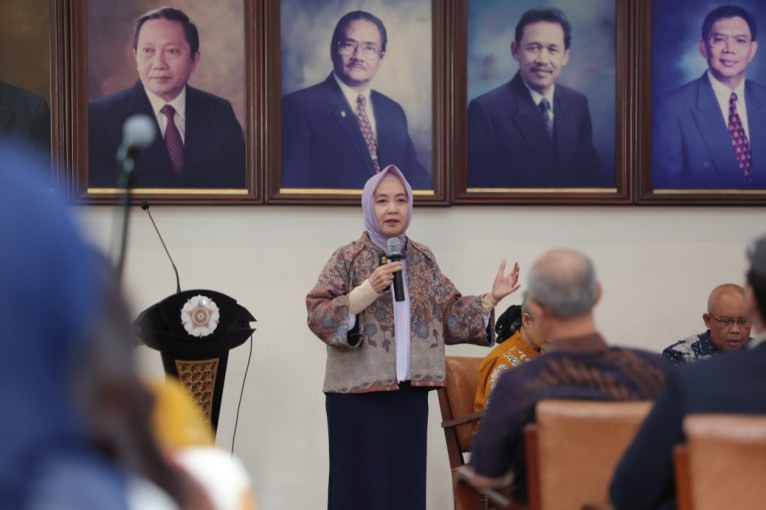
The climate crisis is no longer a threat of the future but a reality already reflected in the increasing frequency of extreme weather events, floods, droughts, and the growing risk of food insecurity. Professor Dwikorita Karnawati of the Department of Geological Engineering at Universitas Gadjah Mada (UGM) explained that climate change is a natural phenomenon that has been accelerated by human activities ever since the Industrial Revolution. She noted that the global temperature increase of approximately 1.55 degrees Celsius over the past 170 years has already exceeded the target previously projected to occur closer to 2100.
“This rapid increase in the Earth’s temperature has made the hydrological cycle increasingly extreme. We are witnessing severe flooding in one region while another experiences prolonged drought. The United Nations has even described this phenomenon as climate boiling,” she said during the Bulaksumur Forum organized by the UGM Board of Professors under the theme “Krisis Iklim, Mitigasi Bencana, dan Inovasi Teknologi Ramah Lingkungan” (Climate Crisis, Disaster Mitigation, and Environmentally Friendly Technological Innovation)” at the UGM Senate Hall on Wednesday (Jun. 24).
According to the former head of Indonesia’s Meteorology, Climatology, and Geophysics Agency (BMKG), the acceleration of climate change has directly contributed to an increase in geohydrometeorological disasters, a term introduced by Professor Dwikorita, including floods, landslides, droughts, and disruptions to food security. If the current pace of climate change cannot be controlled, the world could face a global food crisis in the 2050s due to widespread crop failures in many countries.
“When nearly every country experiences crop failure, we can no longer rely on food imports. Therefore, we must address the root cause now by reducing the drivers of climate change while strengthening communities’ capacity to adapt,” she said.
Professor Dwikorita also emphasized the importance of disaster mitigation strategies that integrate appropriate technology with local wisdom. She shared the experience of UGM Community Service Program (KKN-PPM UGM) students who worked with local communities to map disaster-prone areas while identifying vulnerable groups as the highest priority in community protection systems. According to her, future education should increasingly embrace problem-based learning, enabling students to collaborate directly with communities to solve real-world challenges.
Former Indonesian Minister of Trade, Gita Wirjawan, emphasized the importance of developing high-quality human resources to respond to geopolitical shifts and global technological transformation. He explained that the transition to renewable energy is becoming increasingly feasible as the cost of storing solar energy in batteries continues to decline significantly. He believes this presents Indonesia with a major opportunity to accelerate its energy transition while strengthening its economic competitiveness.
“Economic growth requires electrification. Indonesia’s per capita electricity consumption remains relatively low, making expanded energy capacity a prerequisite for becoming a developed country,” he said.
At the same time, Gita stressed that Indonesia should not merely become a consumer of technology, particularly artificial intelligence, but also a creator of innovation. He noted that countries that have emerged as technological leaders did not necessarily progress in a linear manner but instead made bold leaps by investing in research, innovation, and national capacity building.
Meanwhile, the Dean of UGM’s Faculty of Engineering (FT UGM), Professor Selo, said the faculty continues to foster a culture of innovation inspired by the Panca Brata Herman Yohannes philosophy: becoming innovators, pioneers, patriots, alternative thinkers, and resilient individuals. These values are reflected in the development of sustainable learning facilities such as the Smart Green Learning Center (SGLC) and the Engineering Research Innovation Center (ERIC), which are designed as collaborative spaces for research and environmentally friendly technological innovation.
In addition to developing infrastructure, FT UGM has produced a range of research innovations that have benefited society, including the natural dye Indi and the food quality enhancement technology Gamahumat. According to Professor Selo, innovation should extend beyond scientific publications to strengthen national self-reliance and provide tangible solutions to society’s needs.
The Dean of UGM’s Faculty of Mathematics and Natural Sciences (FMIPA UGM), Professor Kuwat Triyana, emphasized that meaningful change must begin within the higher education system. He argued that conventional lecture-based instruction is no longer sufficient and should be replaced with project-based learning (PBL), which encourages students to address real-world challenges.
He cited waste management as an example of an issue often viewed solely as a technical problem, even though it is closely related to ethics, behavior, and social responsibility. Therefore, compulsory university courses should be designed to be more application-oriented so students become accustomed to working across disciplines to develop solutions with tangible societal impact.
“Education should take students beyond the classroom to solve real problems. In this way, learning produces not only knowledge but also social awareness and problem-solving skills,” he said.
Author: Jelita Agustine
Editor: Gusti Grehenson
Post-Editor: Priyanandaningrat
Photo: Firsto