



Indonesia’s establishment as a sovereign nation cannot be separated from the contributions of Indigenous communities that had lived, developed, and safeguarded the archipelago before the Republic. Even during the Dutch colonial period, Indigenous peoples were recognized through regulations governing customary justice systems and within the legal framework of the time. Yet, the recognition and protection of Indigenous peoples’ rights, particularly customary lands, remain significant challenges faced by Indigenous communities across Indonesia.
The Indigenous Peoples Bill has at last seen a resurgence in activity following a lengthy period of legislative deliberation. The House of Representatives (DPR RI) has officially included the bill in the 2026 National Legislative Program (Prolegnas) Priority List. Despite its inclusion, academics have urged lawmakers to ensure that discussions actively involve Indigenous leaders, civil society coalitions, and other stakeholders.
Dr. Yance Arizona, a constitutional law lecturer at the Faculty of Law, Universitas Gadjah Mada (Law UGM), emphasized that deliberations on the bill must prioritize the principle of Free, Prior, and Informed Consent (FPIC). FPIC serves as a mechanism that guarantees Indigenous peoples’ rights when development is planned within their territories.
Through FPIC, Indigenous communities are fully involved in decision-making processes concerning programs or projects to be implemented. FPIC also provides space for Indigenous peoples to determine their own future, including managing their territories and preserving their cultural heritage.
“They are informed about the benefits, risks, and impacts, and are given the opportunity to decide whether they want to participate, agree, or disagree with a program,” said Dr. Yance during a discussion titled “FPIC (Free, Prior, and Informed Consent) dalam RUU Masyarakat Adat” (FPIC in the Indigenous Peoples Bill”) held on Tuesday (Jun. 23) at Law UGM.
According to Dr. Yance, the FPIC concept first emerged in the medical field as a principle of relationships between doctors and patients before being adopted in broader social contexts. FPIC is important because Indigenous peoples are the parties most knowledgeable about their traditional rights and the conditions of their territories.
However, the absence of an explicit and effective FPIC mechanism within Indonesia’s national legal framework has the potential to trigger conflicts. What often occurs in practice is coercion and the dispossession of customary lands.
“Indonesia does not actually have an FPIC mechanism within its legal framework. It is therefore logical that many conflicts involving Indigenous peoples occur because what takes place is not FPIC, but coercion and the seizure of Indigenous lands and communities,” he said.
Dr. Yance further discussed the development of FPIC frameworks in international law. He highlighted several legal instruments and international standards, including ILO Convention 169 (1989), the UNDRIP (2007), the CBD (1992), and the Nagoya Protocol (Law No. 11 of 2013), as well as business and financial standards such as the Roundtable on Sustainable Palm Oil (RSPO), the Forest Stewardship Council (FSC), the World Bank’s Environmental and Social Standard 7, and the Asian Development Bank’s Safeguard Policy Statement. Regulations in the business and financial sectors often provide stronger recognition of Indigenous rights than national laws.
Dr. Yance also highlighted the limited regulation of FPIC within Indonesia’s legal system.
“If we examine it closely, FPIC principles are actually dispersed throughout several provisions of our Constitution. However, explicit references in statutory laws remain very limited,” he explained.
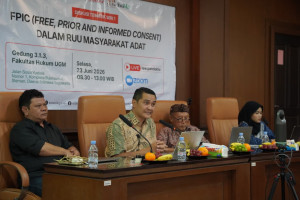
In his presentation, Dr. Yance compared the FPIC dimensions in DPR RI’s version of the Indigenous Peoples Bill with those in the version proposed by the Civil Society Coalition. The analysis covered three key aspects: the basis for decision-making, substantive rights and the right to refuse, and the forms of exchange involved in the consent process.
Overall, he identified four fundamental weaknesses in both drafts: a lack of integration with the licensing system, limited inclusivity, the absence of a clear institutional framework, and the lack of complaint and grievance mechanisms.
As a recommendation, Dr. Yance stressed the importance of fully incorporating FPIC principles into the Indigenous Peoples Bill. He advocated making FPIC a mandatory requirement in licensing processes, accompanied by guarantees of protection for Indigenous peoples, the establishment of a dedicated institution, and the provision of effective grievance mechanisms.
According to him, FPIC serves as a vital bridge toward sustainable development that respects the dignity of Indigenous peoples while upholding constitutional mandates. The bill should become a tangible expression of Indigenous sovereignty.
“The Indigenous Peoples Bill must transform from merely a compensation instrument into a genuine manifestation of sovereignty for Indigenous peoples in Indonesia,” he concluded.
The discussion, initiated by UGM’s Center for Democracy, Constitution, and Human Rights Studies (Pandekha) in collaboration with ASSLESI, HuMa, and the Indigenous Peoples Alliance of the Archipelago (AMAN), featured Professor Bambang Hudayana of Anthropology UGM, who examined decision-making practices within Indigenous communities from an anthropological perspective and the implications of FPIC design.
Customary leaders are highly influential because of their close relationship with their communities. Therefore, the characteristics of Indigenous governance are an essential prerequisite for designing FPIC mechanisms that genuinely serve Indigenous interests.
“If we fail to understand the character of Indigenous governance, we will fail to implement FPIC in a way that truly benefits Indigenous peoples,” he said.
Professor Bambang noted that in many cases, the state pursues development goals by subordinating Indigenous communities. As a result, the voice of Indigenous peoples becomes increasingly limited, weakening the position of customary governance in negotiation processes. Skepticism regarding the implementation of FPIC advocacy spaces for Indigenous peoples continues to shrink. Without strengthening Indigenous organizations, Indigenous interests will be difficult to defend.
“Without empowerment and stronger Indigenous organizations, we cannot expect Indigenous peoples to effectively voice their interests,” he said.
Professor Bambang further outlined three types of Indigenous governance systems in Indonesia. The first is the self-governing community, which independently manages its affairs based on original social structures and serves Indigenous members, as found in the Inner Baduy community. The second is a self-governing community integrated with local self-government, such as the Nagari system in Minangkabau.
The third consists of village administrations without direct customary authority but partner with customary institutions to manage local traditions and cultural affairs, such as administrative villages and Desa Pakraman in Bali. Of these three types, he argued that self-governing communities have the greatest potential for advocacy.
“Among these models, self-governing communities are the most suitable partners for advocacy because there is no state element within their organizational structure,” he added.
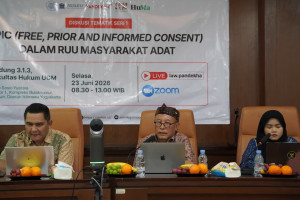
Professor Bambang concluded that the success of FPIC implementation depends on the form of Indigenous governance, the sources of legitimacy for customary leadership, and the structure of customary land rights within each community. Consent processes should not merely involve customary leaders; they must also ensure the participation of rights holders directly affected by policies or development projects.
“Authority over FPIC implementation within Indigenous communities is determined by the interaction between the form of Indigenous governance, the sources of leadership legitimacy, and the structure of customary land rights,” he explained.
Many customary leaders today have been weakened by interventions from both the state and corporations. Strengthening Indigenous organizations and leadership is essential to ensure they remain capable of representing community interests. In practice, FPIC should be implemented through open, participatory, and inclusive deliberation processes so decisions genuinely emerge from collective agreement rather than a small group of elites.
“FPIC must be carried out through participatory deliberation and collective decision-making by communities that hold customary land rights,” he emphasized.
As a recommendation, Professor Bambang stressed the importance of stronger recognition of Indigenous communities as self-governing entities with authority to regulate their internal affairs and their own resources. He encouraged FPIC to be implemented in stages, beginning with rights-holding communities at the grassroots level, accompanied by clear identification of customary land rights holders.
Furthermore, consent processes must be built through open and participatory deliberation rather than the approval of customary elites. Strengthening the capacity of customary leaders is necessary to represent community interests more effectively, ensuring the voices of rights-holding communities become the foundation of every decision concerning land use and the management of customary resources.
Author: Zabrina Kumara
Editor: Gusti Grehenson
Post-editor: Jasmine Ferdian
Photos: aman.or.id and Zabrina