


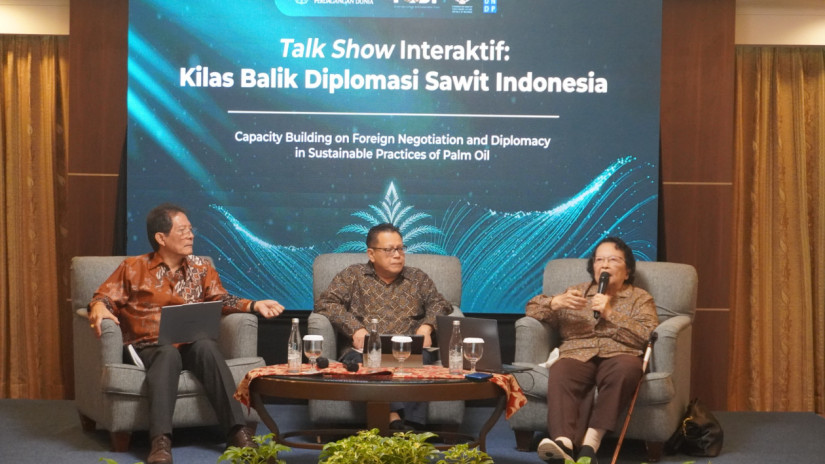
The palm oil industry remains one of the pillars of Indonesia’s economy, supporting the livelihoods of millions of people, including significant contributions from independent smallholder farmers. This strategic position requires highly skilled international trade negotiations to balance economic objectives with climate standards. Strengthening the capacity of Indonesia’s negotiators is therefore essential to advocate for the country’s domestic conservation achievements while bridging national interests with global market expectations.
The issue was highlighted during the Workshop on Developing a Capacity-Building Module for International Negotiation and Diplomacy on Sustainable Palm Oil Practices, organized by the UGM Center for World Trade Studies (PSPD UGM) at the Aston Tropicana Hotel in Bandung, West Java, on June 22–24.
UGM’s Director of Research, Professor Mirwan Ushada, said that the capacity-building program on international negotiation and diplomacy related to sustainable palm oil practices was designed to combine conceptual learning with practical exercises to enhance participants’ competencies in these areas.
“By strengthening the expertise of these representatives, Indonesia can empower its negotiators to become strategic catalysts capable of bridging the gap between national policies and global market expectations,” Professor Mirwan said in a statement received on Friday (Jun. 26).
Director of Primary Product Export Development at the Ministry of Trade, Dr. Miftah Farid, emphasized that expanding access to global markets is not simply about opening new doors but also about understanding regulatory landscapes, consumer preferences, and building sustainable competitiveness.
He suggested that Indonesia follow Malaysia’s example by establishing a dedicated Palm Oil Promotion Agency and utilizing market intelligence. Such an agency would be particularly valuable in target markets such as Africa and the Middle East to strengthen palm oil diplomacy. One option worth considering, he said, is creating a promotion agency dedicated specifically to palm oil.
“This would trigger and encourage more focused strategies and content to counter negative campaigns, including efforts related to sustainability, traceability, and other key issues. Based on our experience and data, the level of community, smallholder farmer, and worker involvement in the palm oil industry is substantial,” he said.
Executive Director of Responsible Sustainable Palm Oil Initiatives, Dr. Rosediana Suharto, said the government must be equipped with robust, indisputable scientific evidence and seriously address weaknesses in environmental and social governance at home to strengthen Indonesia’s position in international negotiations.
“People abroad sometimes underestimate us. Therefore, we must firmly defend our capabilities. In reality, opposition to palm oil is not purely driven by environmental concerns but also by efforts to protect their domestic markets,” Dr. Rosediana explained.
Meanwhile, Dr. Fadhil Hasan of the National Energy Council (DEN), who also serves as Chair of Foreign Affairs at the Indonesian Palm Oil Association (GAPKI), emphasized the need to redirect Indonesia’s palm oil exports toward alternative markets such as Africa, South Asia, and the Middle East. He noted that this shift is necessary because export volumes are projected to decline as domestic demand increases under the B50 biodiesel program.
According to Dr. Fadhil, to ensure the resilience of the palm oil industry and reduce its dependence on temporary global price surges, the government must strengthen downstream development, increase productivity, and maximize the role of trade representatives as the spearhead for expanding into new markets.
“In fact, Indonesia already exports palm oil to 160 countries, so our export destinations are well diversified. The key question is which markets should become our strategic priorities. Palm oil is no longer regarded as a discounted oil but has become a premium oil because its price has risen significantly, partly due to strong domestic demand. Going forward, our strategy should not rely solely on geopolitical windfall profits. Competitive advantage must be built through higher productivity, research and development, and downstream industrialization,” he explained.
Author: Leony
Editor: Gusti Grehenson
Post-Editor: Priyanandaningrat
Photo: PSPD UGM Documentation