


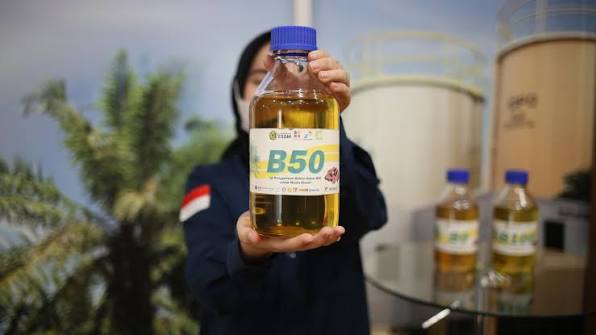
The Indonesian government continues to advance the development of B50 biodiesel as part of its strategy to strengthen national energy security. B50 is a fuel blend consisting of 50% plant-based biodiesel and 50% conventional diesel. The fuel is expected to reduce dependence on imported fossil fuels, increase the added value of Indonesia’s natural resources, and support the transition toward a more environmentally sustainable energy system.
Renewable energy researcher and Faculty of Mathematics and Natural Sciences (FMIPA UGM) lecturer, Professor Karna Wijaya, said that Indonesia’s growing energy demand makes the development of B50 increasingly relevant. In addition to strengthening the domestic energy supply, B50 has the potential to stimulate economic growth through agriculture, plantation, processing, catalyst manufacturing, and renewable energy research sectors.
“However, its success depends not only on the percentage of biodiesel in the fuel blend but also on the availability of sustainable feedstocks, reliable production technologies, consistent quality standards, distribution infrastructure, financing, and fuel compatibility with various types of diesel engines,” said Professor Wijaya on Monday (Jul. 6).
According to Professor Wijaya, biodiesel production in Indonesia currently relies primarily on crude palm oil (CPO) and its derivatives. This is supported by the country’s abundant palm oil production, well-established supply chains, and relatively mature processing industry. Nevertheless, dependence on a single feedstock should be anticipated by diversifying vegetable oil sources to ensure a more resilient and sustainable biodiesel industry.
Several alternative feedstocks are attracting attention, including used cooking oil, tamanu oil (Calophyllum inophyllum), kemiri sunan (Reutealis trisperma) oil, and other non-food vegetable oils. Used cooking oil, for example, has significant potential because it is from households and the food service industry. Its utilization not only reduces environmental pollution but also supports the circular economy by converting waste into value-added products.
“Meanwhile, plants such as tamanu and kemiri sunan produce non-food oils that can be cultivated on marginal land without competing with food production,” he explained.
From a technological perspective, Professor Wijaya explained that biodiesel production involves a series of carefully designed processes to produce high-quality fuel. The first stage is pretreatment, which includes filtration, water removal, degumming, and reducing free fatty acid (FFA) levels. This step is essential because feedstock quality directly affects conversion efficiency and the quality of the resulting biodiesel.
Professor Wijaya explained that feedstocks with high FFA content, such as used cooking oil, must first undergo an esterification process to reduce free fatty acids. Followed by transesterification, a reaction between vegetable oil and methanol using alkaline, acidic, or heterogeneous catalysts. The process produces fatty acid methyl ester (FAME), the primary component of biodiesel, and generates glycerol as a valuable by-product.
The next stage involves purifying the biodiesel to remove residual glycerol, catalysts, methanol, water, and other impurities. The fuel then undergoes quality testing based on key parameters, including density, viscosity, cetane number, water content, oxidation stability, ester content, and flash point.
“Once the biodiesel meets quality standards, it is blended with conventional diesel to produce a homogeneous B50 formulation that complies with usage specifications,” he said.
Before being implemented on a large scale, B50 must also undergo performance testing in various applications, including motor vehicles, heavy equipment, public transportation, ships, agricultural machinery, and diesel-powered generators. These evaluations evaluate fuel consumption, engine performance, emissions, operational stability, material compatibility, and the long-term effects on combustion systems.
As technology advances, biodiesel research has increasingly focused on heterogeneous catalysts based on zeolite, calcium oxide (CaO), zirconia, silica-alumina, and other solid materials. Compared with homogeneous catalysts, heterogeneous catalysts offer several advantages, including easier separation from reaction products, reusability, reduced water consumption during washing, lower waste generation, and improved purification efficiency.
“These characteristics make heterogeneous catalysts increasingly promising for supporting more efficient and sustainable industrial-scale biodiesel production,” he said.
According to Professor Wijaya, B50 development should not be viewed merely as increasing the proportion of biodiesel in diesel fuel, but as part of building a stronger national renewable energy ecosystem.
“The development of B50 must be supported by sustainable feedstock availability, more efficient processing technologies, and guaranteed fuel quality so that it can be optimally used across the transportation and industrial sectors,” he said.
In addition to strengthening energy security, B50 development also offers significant economic and environmental benefits. The program can increase the value of domestic commodities, create new business opportunities, strengthen Indonesia’s biodiesel industry, and encourage greater participation by farmers and businesses in the renewable energy supply chain. Environmentally, biodiesel has the potential to reduce net greenhouse gas emissions compared with fossil fuels, particularly when produced from sustainable feedstocks and processed efficiently.
However, Professor Wijaya emphasized that B50 implementation must proceed gradually and be supported by scientific evidence. Sustainable feedstock availability, stable pricing, distribution infrastructure, national quality standards, and engine compatibility testing are all essential prerequisites before widespread adoption. Meeting these requirements will help ensure that B50 is implemented safely, effectively, and with long-term benefits.
The success of B50 depends on collaboration among the government, universities, the National Research and Innovation Agency (BRIN), the biodiesel industry, vehicle manufacturers, farmers, businesses, and the public. Such collaboration is needed to accelerate the development of alternative feedstocks, advance more efficient catalyst technologies, strengthen national quality standards, and build a resilient, sustainable biodiesel supply chain.
“By strengthening technological innovation, utilizing domestic resources, and fostering cross-sector collaboration, B50 has the potential to become a key pillar in building a more independent, competitive, and sustainable energy system for Indonesia,” he concluded.
Author: Hanifah
Editor: Gusti Grehenson
Post-editor: Jasmine Ferdian
Photo: Ministry of Energy and Mineral Resources