


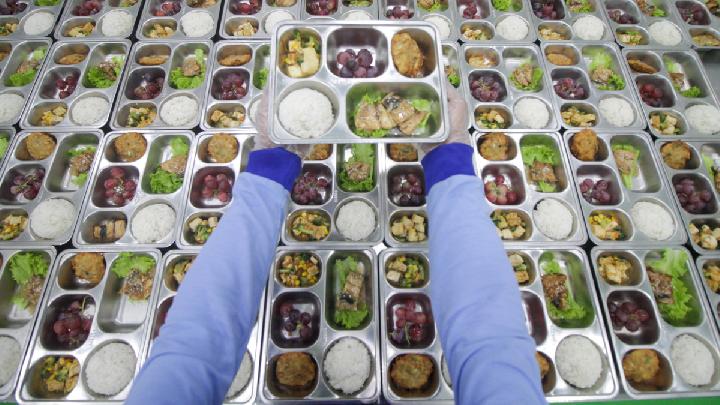
The Free Nutritious Meals (MBG) program, initiated by the government to improve students’ nutritional status, is instead facing serious food safety issues. According to data from the Indonesian Education Monitoring Network (JPPI), from early 2025 to April 2026, at least 33,626 students reportedly suffered food poisoning suspected to be linked to the MBG program. This condition raises questions about the program’s implementation, which continues to face various challenges.
Professor Sri Raharjo, a Professor of Food and Agricultural Product Technology at the Faculty of Agricultural Technology, Universitas Gadjah Mada (Agriculture UGM), observed that throughout 2025, food poisoning incidents within the MBG program occurred almost every month. This indicates that from the outset of its implementation, the program has faced serious preparedness issues.
“Perhaps only one or two months had no reports. Otherwise, incidents occurred almost every month, with fluctuating case numbers,” he said on Friday (Apr. 24).
According to Professor Raharjo, these incidents indicate the unpreparedness of the Nutritional Fulfillment Service Units (SPPG) in providing safe food. This lack of readiness is not confined to a single region but is scattered across various areas. Moreover, with a production target of up to 3,000 portions per day, he believes this exceeds the reasonable capacity of newly established SPPG units.
He also noted that various criticisms and feedback previously conveyed to relevant authorities, particularly the National Nutrition Agency (BGN), have not been fully accommodated. Although there have been corrective measures, such as closing SPPG units that do not meet standards, Professor Raharjo considers them reactive.
“It may appear as disciplinary action, but in reality, the initial problem was that the preparation was forced to proceed,” he explained.
Furthermore, Professor Raharjo emphasized that the root of the issue lies in the initial policy that set large-scale production targets simultaneously. The MBG program, which aims to serve tens of millions of students, led the government to establish a production target of around 3,000 portions per SPPG per day. He estimated that serving approximately 80 million students would require nearly 30,000 SPPG units.
He stressed the importance of a gradual approach in large-scale food production. According to her, SPPG units should begin with smaller capacities, such as 500 portions per day, while undergoing evaluation before increasing output.
“From there, lessons can be learned about handling 500 portions, and the results can determine whether it is feasible to triple the capacity. This staged approach was not anticipated due to the rush,” he added.
From a technical perspective, Professor Raharjo highlighted the risks involved in food processing. He cited chicken as an example of a commonly used animal protein source due to its availability and lower cost compared to fish or beef. To meet the 3,000-portion requirement, hundreds of chickens must be cooked quickly. Additionally, the interval between cooking and consumption can reach several hours.
“If food is not properly processed from the start, the risk of contamination increases,” he explained.
Professor Raharjo also pointed out the significant difference between cooking raw chicken directly and using chicken that has been pre-boiled and stored in a freezer. He explained that pre-boiling chicken ensures even heat distribution and effectively kills bacteria. Subsequent freezer storage is part of safer production management, allowing the chicken to be reheated or seasoned without prolonged cooking when served.
In contrast, cooking large quantities of raw chicken directly, especially by stir-frying or dry-heat methods, may not produce evenly distributed heat throughout the meat. This poses a risk that some portions may not be fully cooked, allowing bacteria to survive and multiply during the interval before consumption.
“It is relatively difficult to ensure that every piece among hundreds in a single pan is fully cooked. This means there is a risk that some portions may not eliminate disease-causing germs or bacteria,” he said.
Worker fatigue also contributes to the problem. Production processes that begin early in the morning and continue daily over long periods may reduce workers’ accuracy. He also mentioned that menu selection should take safety into account.
“Some cooking methods, such as frying, are actually safer in terms of hygiene because high temperatures can kill bacteria. However, these methods are often avoided because they are considered less healthy due to fat content,” he said.
On the other hand, Professor Raharjo emphasized that if the goal of MBG is to improve nutritional status, the beneficiaries should be the most vulnerable groups. He noted that data show stunting affects around 20 percent of children, and if the program prioritizes this group, the number of beneficiaries would be significantly lower than the initial target of 80 million. This approach is considered more realistic compared to the overly broad initial target.
“If focused on those who truly need it, the number is much smaller, and food safety becomes more manageable,” he concluded.
Author: Hanifah
Post–editor: Zabrina Kumara
Photo: Antara News