


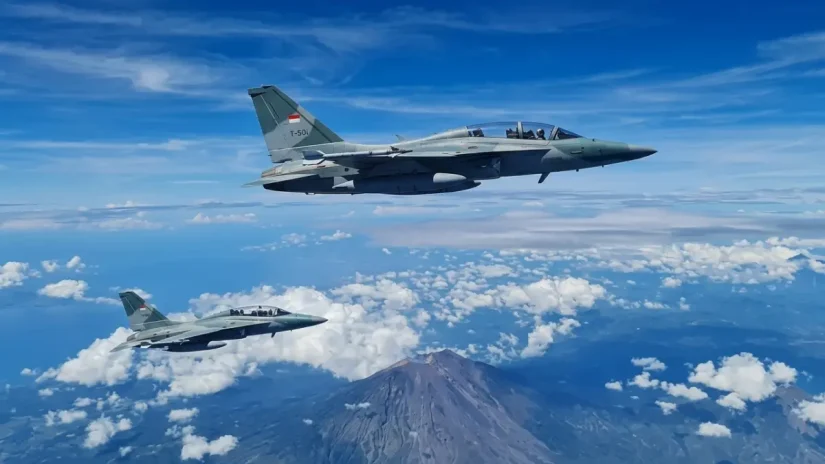
Defense cooperation between the Indonesian government and the United States has opened the possibility of granting permits for U.S. military aircraft to pass through Indonesia’s airspace, sparking controversy and public opposition. The Maritime Defense Cooperation Program (MDCP) agreement includes an overflight clearance clause that allows U.S. military aircraft to traverse Indonesian territory without requiring permission for each flight. This provision is considered a potential threat to Indonesia’s territorial sovereignty and national interests.
Professor of Philosophy at Universitas Gadjah Mada and Head of the Master’s and Doctoral Program in National Resilience Studies at UGM Graduate School, Professor Armaidy Armawi, emphasized the importance of maintaining Indonesia’s astropolitical sovereignty. Regarding the possibility of foreign military movements or interactions with major powers permitted to cross Indonesian airspace, Professor Armaidy stressed that the government, particularly the Ministry of Defense, must always prioritize national sovereignty and interests in accordance with the 1945 Constitution.
“Indonesia loves peace, but it loves independence more. When we speak of independence, sovereignty is non-negotiable. Sovereignty, in essence, represents national interest,” he said on Thursday (April 23).
In addition to adhering to the Constitution, he reminded that the government should not act unilaterally in responding to such issues. Instead, it must reconsider Indonesia’s position within ASEAN.
Therefore, the Indonesian government needs to engage neighboring countries to address this matter collectively. Moreover, the current global geopolitical landscape is undergoing shifts.
“In the United States itself, there is what is known as the law of diminishing returns. When power is continuously pushed, it can turn against itself. This is something our leaders must be able to read,” he explained.
Armaidy also underscored that the principle of diplomacy is ‘to sit equally low and stand equally tall,’ meaning that all countries are equal in diplomatic relations. Indonesia must exercise caution when making decisions on cooperation, particularly those that affect the broader public interest.
“Therefore, prudence is essential. Our foreign policy must also reflect the principles of our domestic policy,” he said.
Responding to the rapidly shifting global power dynamics, he added that Indonesia’s diplomatic approach must also move swiftly.
“We must reassess and develop a new paradigm. In a rapidly changing geopolitical landscape, we must clearly evaluate what we have done and align it with the principles enshrined in our Constitution,” he concluded.
Author: Leony
Editor: Gusti Grehenson
Post-Editor: Zabrina Kumara
Photo: Indonesian Air Force Documentation