


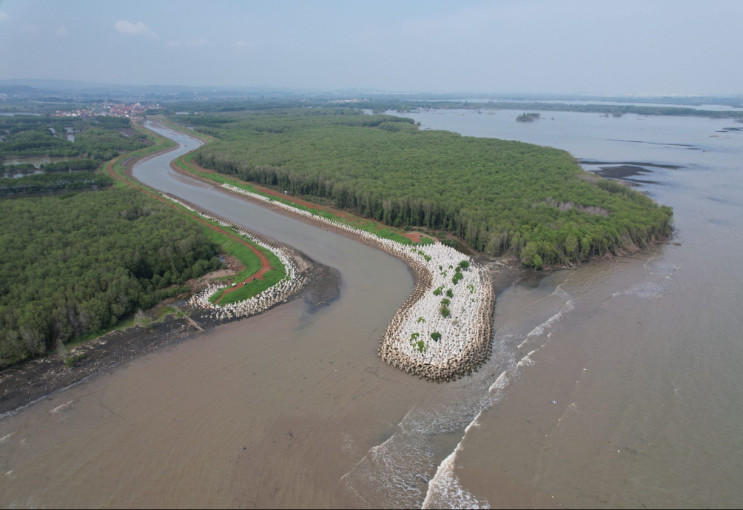
The government is finalizing plans to build a seawall, or “Giant Sea Wall,” along the North Coast of Java (Pantura). The plan to construct the sea wall in the Pantura area was first initiated in 1995 and was revisited by President Prabowo Subianto during the International Conference on Infrastructure in mid-June 2025. The government argues that the seawall aims to protect Pantura’s coastal areas, which are frequently affected by climate change and rising sea levels.
A lecturer at the Faculty of Geography (Geography UGM), Bachtiar Wahyu Mutaqin, assessed that constructing a sea wall along Pantura is not an urgent necessity when viewed from the geographical context of the region, which is dominated by alluvial plains that are flat, sandy, and characterized by relatively protected wave exposure with an average elevation of less than two meters. In his view, there are several alternatives the government could prioritize over building a seawall.
“There are many more reasonable options than giant sea walls, such as optimizing the function of coastal ecosystems, coastal zoning, or wetland restoration,” he said on Thursday (4/23).
Bachtiar suggested that the government’s chosen option creates a placebo effect, which, in this context, refers to the belief that environmental improvement efforts will produce significant impacts, even though no concrete changes are visible and the main problem may remain unresolved.
“This option tends to be chosen because it creates a placebo effect. It appears tangible, even though it may not actually solve the problem,” he explained.
Furthermore, Bachtiar highlighted the connection between the sea wall plan and land subsidence, which is a major issue in the Pantura region. According to him, a sea wall is not a solution to land subsidence. Instead, the urgency lies in spatial planning, particularly concerning large industries located along the Pantura coast that rely heavily on groundwater extraction.
“If the issue is land subsidence, the more urgent matter is spatial planning, especially for large industries along the coast,” he said.
Bachtiar explained that the material conditions along the Pantura coastline are dominated by geologically young alluvial deposits, such as sand and gravel that are not yet compacted.
“If large and heavy structures are built on land dominated by these alluvial materials, they can press down the surrounding surface. This is exacerbated by massive groundwater use by large industries, which accelerates land subsidence,” he added.
Regarding the coastal dynamics impact of the project, Bachtiar is confident that it will affect sediment distribution patterns, currents, and waves. He noted that some areas could experience severe erosion as a result of the project.
Examples of such changes can already be observed in Semarang and the eastern side of Jakarta when viewed via Google Maps or Google Earth Pro.
“It will certainly affect sediment distribution patterns, currents, and waves,” he said.
Regarding whether the sea wall project can protect coastal areas from sea-level rise due to climate change, Bachtiar believes this measure is neither a proper, targeted, nor effective solution. In his view, there are still many other options available to prevent and address the multi-hazard impacts of climate change along the Pantura coast.
“There are many other options to address the multi-hazard impacts of climate change,” Bachtiar said.
In the context of potential damage to coastal ecosystems, such as mangroves and fish habitats, resulting from large-scale construction and reclamation, he argued that the project could also have significant impacts.
“Multi-hazards from climate change include ecosystem degradation, gradual inundation, seawater intrusion, coastal erosion, and tidal flooding,” he stated.
In addition, potential damage may arise from changes in sea currents and sediment movement. Bachtiar explained that these changes could make it difficult for mangroves, seagrass, and coral reefs to grow because they lose suitable “living space”.
“Changes in oceanographic and sediment factors can reduce the substrate where mangroves grow,” he explained.
In fact, these three ecosystems are crucial as breeding and feeding grounds for fish and marine biota. If these ecosystems are damaged, marine life will inevitably be disrupted.
The impacts would not stop at the environment but would also affect coastal communities. Traditional fishers would be among the most affected, as declining fish availability from habitat destruction would make it increasingly difficult for small-scale fishers without substantial capital to earn a living.
“Traditional fishers without capital will face greater difficulty in catching fish,” he said.
When compared with countries such as the Netherlands, Bachtiar emphasized that not all concepts can be applied directly in Indonesia. Each region has different natural and social conditions. This means that solutions to Pantura’s coastal issues should be tailored to local geographic contexts rather than simply imitating those of other countries.
“No. We must consider the local context and geographical conditions,” he concluded.
Author: Zabrina Kumara
Editor: Gusti Grehenson
Post-editor: Rajendra Arya
Photo: Walhi Jateng