


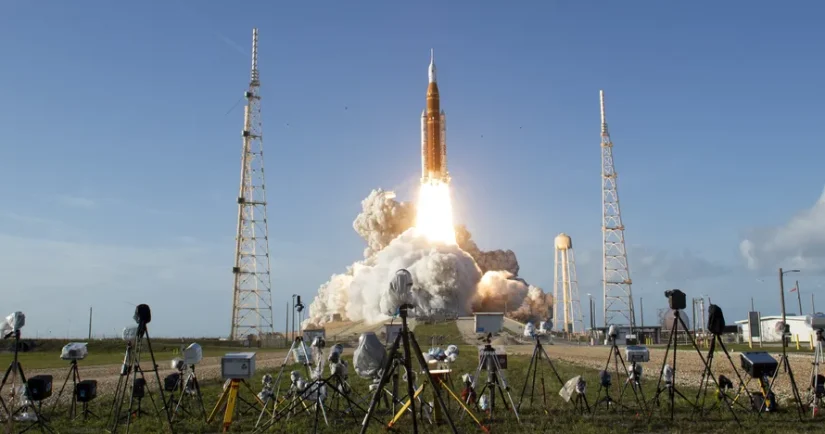
Four astronauts participating in the Artemis II mission successfully returned to Earth on Friday (Apr. 10) local time after completing a 10-day journey orbiting the Moon. The success of Artemis II not only opens the possibility of humans returning to the Moon but also offers significant opportunities for researchers in Indonesia to contribute to space research and technology.
A lecturer at the Department of Physics, Faculty of Mathematics and Natural Sciences, Universitas Gadjah Mada (FMIPA UGM), Dr. Dwi Satya Palupi, stated that this achievement demonstrates substantial progress compared to the Apollo program era, which took place more than five decades ago. According to her, today’s spaceflight systems are much safer, particularly in passing through the high-risk phases of exiting and re-entering Earth’s atmosphere.
“I believe this mission to the Moon marks a major leap compared to the Apollo Program era, as current technology has undergone extensive evaluation from past failures,” she said on Thursday (Apr. 23).
Through this achievement, Dr. Palupi sees greater opportunities for humans to return to the Moon. However, several challenges remain, including the Moon’s lack of atmosphere, extremely harsh temperatures, high levels of cosmic radiation, and limited oxygen and other life-supporting resources. Even so, she believes these challenges will drive further advancements in science and technology.
“Challenges in outer space will actually encourage new research so that humans can reach there safely and survive,” she said.

In addition, the success of Artemis II opens significant opportunities for Indonesia, particularly for the National Research and Innovation Agency (BRIN), to contribute to space exploration.
She mentioned that these opportunities include strengthening research in aerospace technology, satellites, data transmission, and the development of materials resistant to extreme space conditions.
“Aerospace technology, satellites, and data transmission are no longer impossible ideas but have become real necessities,” she remarked.
Furthermore, Dr. Palupi emphasized the importance of the government’s serious attention to technological development, particularly through BRIN’s potential research collaboration with the National Aeronautics and Space Administration (NASA), so that young generations have opportunities to compete globally.
She also hopes Indonesia can contribute innovations in materials science, such as proposing strong materials suitable for space instruments.
“Support should not be limited to funding alone but also directed toward opening access to collaboration with international institutions so that young Indonesian researchers can be directly involved in space research,” she concluded.
Author: Cyntia Noviana
Editor: Gusti Grehenson
Post-editor: Rajendra Arya
Photo: Getty Images and NASA