


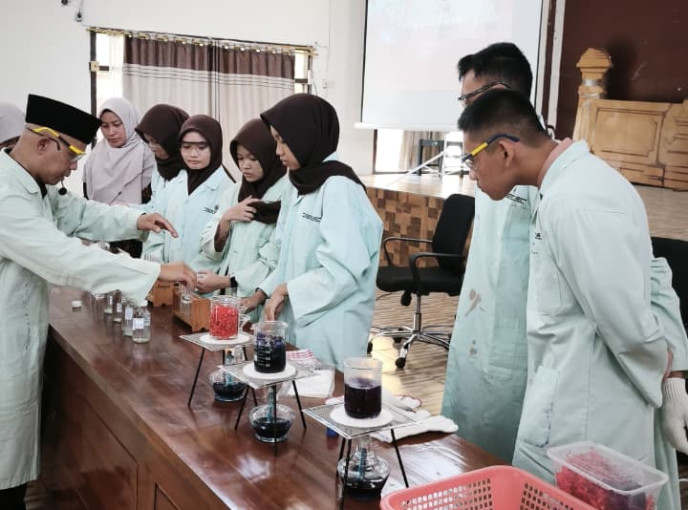
A total of 50 chemistry teachers and 100 high school students from across Kediri Regency, East Java, participated in the Capacity Building Workshop for High School Teachers and Students titled “Bahan Alam Asli Indonesia: Manfaat dan Sumber Belajar Tanpa Batas” (Indonesian Natural Products: Benefits and Unlimited Learning Resources) on Friday (Jun. 26) at SMA Negeri 1 Kediri. Organized by the Organic Chemistry Laboratory of the Department of Chemistry, Faculty of Mathematics and Natural Sciences Universitas Gadjah Mada (FMIPA UGM), the workshop aimed to enhance teachers’ and students’ competencies in utilizing Indonesia’s natural products as contextual, innovative, and sustainable chemistry learning resources.
Dr. Endang Astuti, representing the Department of Chemistry at FMIPA UGM, said that Indonesia possesses abundant natural resources that can serve as engaging and scientifically valuable learning media.
“Teachers and students should continue to be encouraged to explore this potential through scientific approaches,” she said.
According to Dr. Astuti, the community engagement program reflects the Department of Chemistry’s commitment to improving the quality of science education at the secondary school level while introducing young people to higher education.
“Through interactive, inspiring, and hands-on activities, participants are invited to gain a deeper understanding of chemistry, campus life, and career opportunities in science and technology,” she explained.
Dr. Deni Pranowo, M.Si., Head of the Community Service Team at the Organic Chemistry Laboratory, Department of Chemistry, FMIPA UGM, said the workshop was designed to foster young people’s interest in science, particularly chemistry, while providing a firsthand introduction to university academic life.
“We hope this activity inspires students’ curiosity, creativity, and motivation to continue learning and pursue higher education. By presenting science in an engaging and inspiring way, we want to demonstrate that scientific knowledge is one of the keys to building the nation’s future,” he said.
Through collaboration between universities and secondary schools, the organizers hope to nurture a generation with strong scientific literacy, a lifelong passion for learning, and the readiness to become future scientists, innovators, and leaders who can make meaningful contributions to Indonesia’s development.
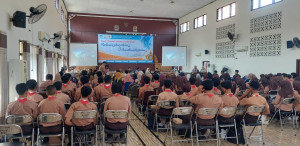
The workshop received an overwhelmingly positive response from participants. Through a variety of interactive sessions, students not only gained insights into university life and study opportunities at FMIPA UGM but also participated directly in engaging and practical chemistry experiments.
One participant from SMA Negeri 1 Kediri, Julita Sulistya Eka, shared her impressions of the workshop.
“The event was exciting and enjoyable. I used to think chemistry was a difficult subject because there were so many theories to memorize. However, after joining the Fun Chemistry session and learning from the professors about chemistry research, I realized that chemistry is closely connected to everything around us,” she said.
Meanwhile, Yemima Brenda Chrissia, an eleventh-grade student at SMA Negeri 1 Pare, expressed her appreciation to the FMIPA UGM community service team for providing students with this learning opportunity.
“This activity was very beneficial because it gave us new insights into university life, especially at UGM. I hope the knowledge we gained today will help us achieve our future goals,” she said.
Separately, Arif Syah Putra, Principal of SMA Negeri 1 Kediri, stated that collaboration between schools and universities is a strategic step toward providing learning experiences that are relevant to scientific developments and future needs.
Through this program, the Organic Chemistry Laboratory of the Department of Chemistry, FMIPA UGM reaffirmed its commitment to bridging university education and research with societal needs, particularly in the education sector. The organizers hope the initiative will strengthen teachers’ competencies, increase students’ interest in science, and encourage the use of Indonesia’s natural products as creative, innovative, and sustainable learning resources.
The workshop featured experts from the Department of Chemistry, FMIPA UGM, who shared their knowledge and experience on incorporating Indonesian natural products into chemistry education. Topics included the introduction of Green Chemistry education in high schools, which can help reduce environmental impacts and make chemistry education more relevant. Participants also learned about various Indonesian natural dyes, their sources, chemical characteristics, and potential applications as teaching materials and value-added products.
One of the workshop’s most engaging sessions was Fun Chemistry, during which participants took part in hands-on laboratory activities and chemistry demonstrations that were safe, enjoyable, and easy to replicate. Activities included using natural dyes as pH indicators, demonstrating simple chemical reactions that produce color changes, and making aromatherapy candles to illustrate the application of organic chemistry in everyday life. Through an experiential learning approach, participants discovered that chemistry is not merely theoretical but a practical science closely connected to daily life.
As the highlight of the workshop, participants participated in a practical session to create their own perfumes. During the session, teachers and students practiced using natural dyes as pH indicators and explored essential oils as locally sourced materials for chemistry learning. The experiments were designed to be easily replicated in schools using simple equipment and readily available materials.
The workshop concluded with an inspiring Discussion and Sharing Session, encouraging participants to develop a positive mindset, strengthen their enthusiasm for learning, and prepare themselves to face future challenges in an era of rapidly advancing science and technology.
Author: Jelita Agustine
Editor: Gusti Grehenson
Post-editor: Zabrina Kumara
Photo: FMIPA Documentation