


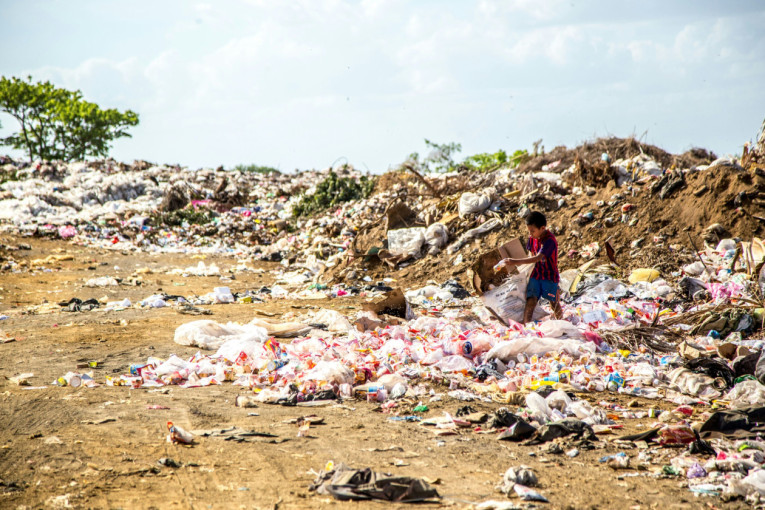
Open dumping practices remain widespread in Indonesia. This conventional waste management method, which involves piling up waste without protection, sorting, or further processing, has actually been banned by the government. According to a report from the Ministry of Environment/Environmental Control Agency (KLH/BPLH), by the end of 2025, around 30 percent of the 485 landfills across Indonesia had stopped practicing open dumping.
Professor Chandra Wahyu Purnomo of the Department of Chemical Engineering, Faculty of Engineering, Universitas Gadjah Mada (FT UGM), stated that open dumping practices have, in fact, already been prohibited. Regional governments that continue the practice could even face criminal penalties. According to Professor Purnomo, the current challenge stems from the limited budget allocation for waste management in regional administrations.
“The main issue is funding. Regional budget allocations for waste management are only around 1 percent, and in some areas even lower than that,” he said on Friday (May. 7).
Although the government is currently developing Waste-to-Energy Processing Facilities (PSELs) or Waste-to-Energy Power Plants (PLTSa) to replace open dumping, these facilities are being built only in areas that generate around 1,000 tons of waste per day across 30 regions.
“I think this program could become one of the solutions so that open dumping practices can be redirected,” he said.
Professor Purnomo explained that banning open dumping is essential because the practice poses risks of fires and landslides. This waste management method creates large landfill pits for storing compacted waste.
“As waste decomposes, it produces methane gas. In open dumping sites, exposure to heat can trigger fires and explosions,” he explained.
Professor Purnomo acknowledged that open dumping practices persist because regional governments have insufficient waste management budgets. As a result, waste piling continues.
“Due to budget limitations, local governments can only afford to collect and pile up waste,” he added.
In addition, public awareness of waste sorting remains low due to unclear regulations and their implementation. Therefore, Professor Purnomo emphasized the need for the government to implement a clearer waste-sorting system, including waste categories, collection schedules, and transportation responsibilities.
“Although many regional governments have issued emergency waste notices, communities remain powerless because adequate facilities are still lacking,” he said.
According to him, community waste management practices still largely rely on subscription-based truck services operated by independent waste management groups known as Pengelola Sampah Mandiri (PSM). Problems arise when waste is not sorted from the beginning. Under the PSM system, waste is independently collected and transferred to Temporary Disposal Sites (TPS) before regional government fleets transport it to Final Disposal Sites (TPA).
“If waste sorting at the source is unclear, downstream management will inevitably become problematic as well. The entire system needs improvement. Even informal systems can be transformed into semi-formal ones through proper guidance and standardized equipment,” he explained.
Professor Purnomo also highlighted the growing number of illegal waste-burning facilities that have emerged due to the closure of several landfills. The equipment used often resembles simple incinerators with inadequate emission controls. Waste containing chlorine compounds can produce dioxins and furans when burned. These substances are known to cause cancer and autoimmune diseases that are difficult to treat. This differs from official incinerators, which use methods that properly filter emissions before releasing smoke into the air.
“The waste may disappear because it is burned, but the smoke is toxic. Nearby residents end up inhaling it every day,” he said.
From the downstream perspective, he noted that the government is attempting to develop PSEL facilities using modern incinerators. Meanwhile, academics can contribute by developing smaller-scale technologies such as pyrolysis systems. This method enables certain types of plastic waste to be converted into fuel oil.
“To produce good-quality fuel, the plastic must be clean, and if mixed with PVC, it still creates problems,” he explained.
According to Professor Purnomo, the government could collaborate with academics to address waste management challenges at both upstream and downstream levels. Through simple technologies, waste can be transformed into paving blocks, biogas, fertilizer, or even gaseous fuel.
However, all of these efforts require stronger public habits of waste sorting as well as better guidance for independent waste transport operators.
Author: Hanifah
Editor: Gusti Grehenson
Post-editor: Jasmine Ferdian
Photo: Hermes Rivera/Unsplash