


Indonesia’s Central Statistics Agency (BPS) recently reported a decline in the poverty rate. However, realities on the ground suggest otherwise, showing that poverty remains a complex multidimensional issue found in nearly every region of the country.
Research conducted by the Center for Population and Policy Studies at Universitas Gadjah Mada (PSSK UGM) found that many people living in remote areas are trapped in structural poverty due to top-down policies imposed by the central government. Policies such as the designation of conservation areas without community involvement have deprived residents of access to land management and infrastructure development, leaving them isolated and burdened with extremely high transportation, education, and basic living costs. These findings were discussed during the Population Corner (Popcorn) podcast titled “Membongkar Akar Kemiskinan Struktural Indonesia” (Unpacking the Roots of Structural Poverty in Indonesia), organized by PSKK UGM on Friday (June 5).
PSKK researcher Sri Purwatiningsih, commonly known as Nining, explained that communities in many remote regions are caught in a poverty trap due to isolation.
“People also continue to experience natural poverty, a condition that arises from injustice within social, economic, and institutional systems,” she said.
According to Nining, poverty is not merely a matter of numbers and statistics but rather a deeply rooted issue spanning social, cultural, and geographical dimensions. As an example of the cultural dimension, she pointed to local social pressures that make poverty harder to escape, such as the tradition of contributing to extended-family ceremonies (Tombol Romak) in Fakfak, which can impose significant financial burdens on households.
“People may become poor because of limited access, the absence of infrastructure, or a lack of available resources in their surroundings,” she explained.
Beyond infrastructure challenges, Nining argued that BPS poverty measurement standards remain overly “Java-centric” and are often less relevant when applied to regions outside Java, such as Kalimantan or Papua. This became evident when the PSKK UGM research team developed locally based welfare indicators in Fakfak. The initiative resulted in a much more targeted model for distributing local government assistance.
“In Fakfak Regency, we conducted a poverty census, although we did not call it a poverty census. Instead, we referred to it as a socioeconomic welfare census. We developed our own indicators based on BPS indicators as a foundation, but many aspects were revised. It turned out to be effective, and local stakeholders preferred this approach,” she said.
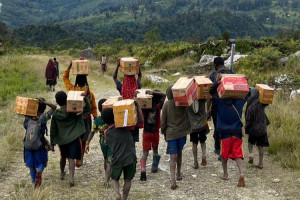
To address poverty, Nining emphasized the need to improve development policies by expanding access and accelerating infrastructure development. Greater access would enhance purchasing power and improve access to essential public services. At the same time, the government must address the mismatch between basic needs and the resources available to communities.
Equally important, she said, is improving connectivity between regions to reduce isolation, particularly in areas outside Java.
“Connectivity in Java may already be relatively good. However, outside Java, connectivity remains a major challenge. Many people remain poor because transportation and regional connections are still inadequate, leaving them isolated,” she explained.
In addition, she urged both central and local governments to demonstrate a stronger commitment to tackling poverty, which continues to affect large segments of society. Participation from all stakeholders is also necessary to promote welfare across all levels of society, particularly among marginalized and underserved communities.
Author: Leony
Editor: Gusti Grehenson
Post-editor: Zabrina Kumara
Photo: Kompas and Indonesian Ministry of Social Affairs Archives