


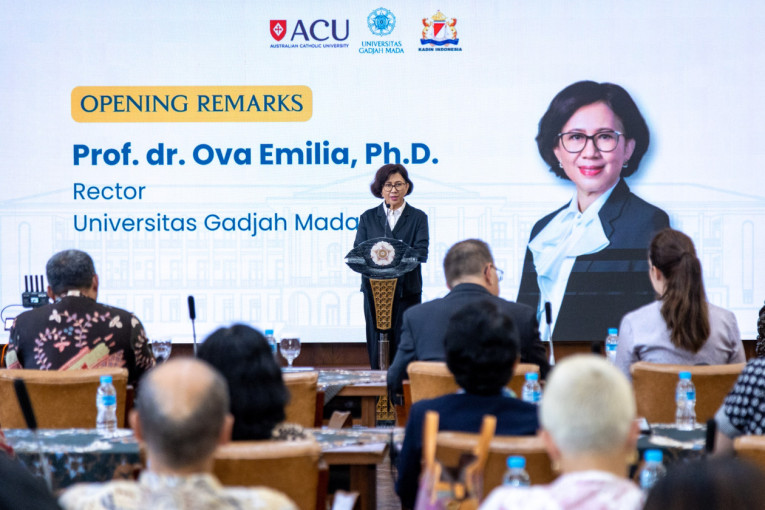
Universitas Gadjah Mada (UGM) and Australian Catholic University (ACU) have collaborated to launch the Human Flourishing Center on Thursday (Apr. 23) at the Senate Hall, UGM Central Building. Through the establishment of this research center, both universities aim to gain insights into human well-being and prosperity that go beyond economic indicators and material aspects. This concept encompasses various complex dimensions, including physical and mental health, meaningful social relationships, purpose in life, and the development of character and wisdom.
UGM Rector, Professor Ova Emilia, welcomed the establishment of the human flourishing research center through this collaboration between the two universities. Universities not only advance knowledge and education but also foster human well-being, goodness, and social inclusion. The establishment of the Human Flourishing Center marks a significant step in building a human well-being research ecosystem in Indonesia and Australia.
“Efforts to build human well-being require sustained support from various stakeholders, not only universities as academic partners but also the government, private sector, communities, as well as religious and community leaders. We hope this collaboration will bring meaningful benefits, not only for Indonesia and Australia but also for the global community,” she said.
Professor Ova added that the research center is expected to explore levels of well-being in Yogyakarta. She noted the relatively low income levels of residents in the Special Region of Yogyakarta compared to other regions, yet also cited high resilience and happiness indices, creating a social paradox.
“This research project is not only about education and research but is also community-based,” she noted.
One follow-up initiative of this collaboration is the opening of a joint doctoral (PhD) program in Inter-Religious Studies (IRS) between UGM and ACU at the UGM Graduate School.
Professor Ova also highlighted that Indonesia offers a context in which culture and various elements shape resilient individuals, while Australia contributes to strong scientific advancements.
“This is what we will learn. We will learn from best practices and positive developments in the field. We do not view success and well-being solely through numerical indicators,” she concluded.
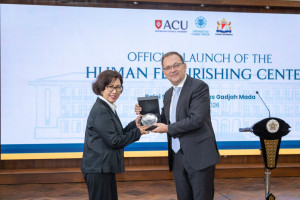
Professor Zlatko Skrbis, Vice-Chancellor of ACU, expressed his appreciation to all parties supporting this collaboration. In his remarks, he reflected on messages from the late Pope Francis regarding how advances in knowledge can threaten human empathy. Therefore, education must always be accompanied by the values of truth.
He also emphasized the importance of maintaining diversity amid differences and the need to consider multiple sectors in achieving societal well-being.
“The Pope reminded us that forces promising progress can also trigger exclusion and power imbalances, where technology may reduce our empathy,” he explained.
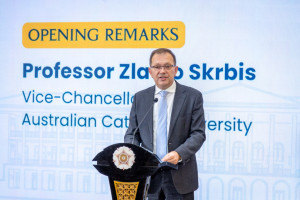
Professor Skrbis further noted that one of the roles of the Human Flourishing Center is to help understand the negative impacts of progress. He pointed out that society often focuses on advancements while overlooking those who are left behind. This collaboration seeks to address such gaps.
“We are truly trying to understand the inequalities that emerge as societies grow, when measurable progress improves. Yet, such progress often leaves some people behind,” he said.
Naila Mazzucco, Southeast Asia Commissioner of the Victoria Government, also expressed her support for the project. She noted that many universities in Victoria have collaborated closely with UGM across various fields.
“From the perspective of the Government of Victoria, this is a partnership we are very proud to support, and we look forward to being part of this journey,” she said.
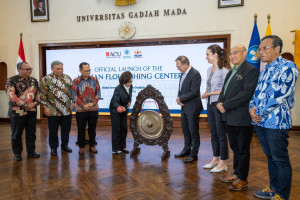
Meanwhile, Yohanes Jatmiko, Consul General of the Republic of Indonesia in Melbourne, expressed his appreciation. He stated that human flourishing is important because it captures the true meaning of individuals and communities thriving fully, not merely surviving or achieving economic growth. Economic growth can foster skills and motivation that lead to more productive and innovative ideas.
“We see this research center as a strategic platform that strengthens Indonesia’s collaboration, advances interdisciplinary education, and encourages community engagement,” he said.
Bernardino Moningka Vega, Vice Chair of the Indonesian Chamber of Commerce and Industry (Kadin), stated that while technological and business developments continue to advance, culture remains inseparable.
“Of course, we want our GDP and GDP per capita to grow. However, beyond that, can we contribute from the business sector by introducing a new paradigm where human development within society becomes a central effort, growing through a human-centered and innovation-driven approach integrated across all sectors,” he concluded.
Professor Abid Khan, Deputy Vice-Chancellor Research and Enterprise at ACU, expressed hope that this collaboration will benefit many stakeholders. He emphasized that the research center represents a shared commitment between UGM and ACU to better understand what truly enables individuals, communities, and societies to flourish fully.
Author: Leony
Editor: Gusti Grehenson
Post-editor: Jasmine Ferdian
Photo: Donnie