


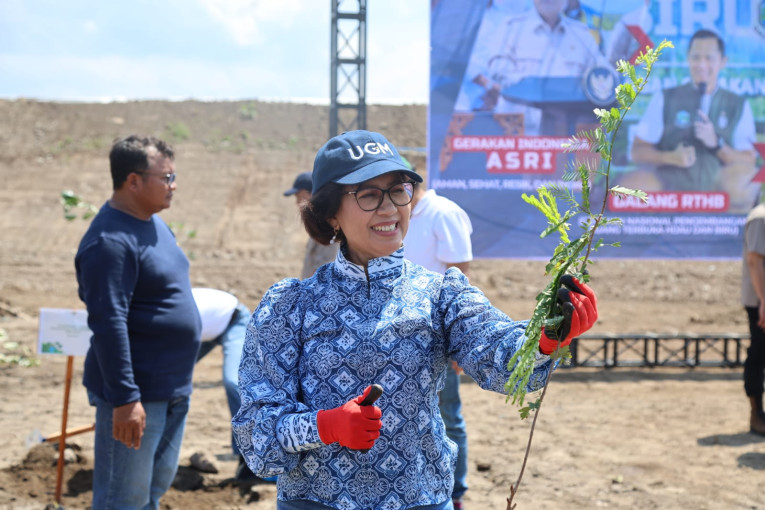
Universitas Gadjah Mada (UGM) has reaffirmed its commitment to supporting sustainable development through cross-sector collaboration. Coordinating Minister for Infrastructure and Development Agus Harimurti Yudhoyono (AHY), along with officials from various ministries, partnered with UGM in a tree-planting initiative in the green corridor area along the Prambanan-Purwomartani toll road section on Saturday (April 25).
This activity forms part of a concrete effort to create green open spaces amid rapid infrastructure development. In addition to serving as an ecological buffer, green corridors are expected to improve environmental quality and support climate change mitigation.
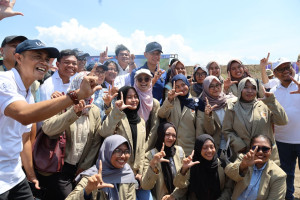
Several members of the UGM academic community attended the event, including the Dean of the Faculty of Forestry (Forestry UGM) and students who directly observed the planting site.
In his remarks, AHY emphasized the importance of multi-stakeholder collaboration in designing and implementing development policies. He noted that the government not only promotes conceptual frameworks but also encourages tangible action through a pentahelix approach.
“I told the Rector that we always strive to apply the pentahelix approach, not merely as a theory but through direct action,” he said.
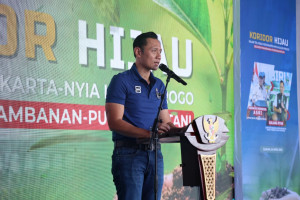
According to AHY, the involvement of universities such as UGM is crucial in ensuring that policies are research-based and have a direct impact on society. He also stressed that infrastructure development must adopt a people-first approach, with the ultimate goal of improving public welfare and happiness.
He further underlined that development challenges are becoming increasingly complex, particularly with the emergence of ecological threats. In his view, the concept of survival interest is no longer limited to military threats but also includes a nation’s ability to respond to environmental crises such as deforestation, pollution, and greenhouse gas emissions.
“Indonesia’s geographical position within the Ring of Fire increases disaster risks, requiring responsive and sustainable policies,” he explained.
In this context, the development of green open spaces is seen as a strategic solution. AHY noted that achieving the 30 percent green open space (RTH) target in every city remains challenging, particularly due to land constraints amid ongoing development. Therefore, utilizing green corridors along toll roads is considered a relevant innovation to address this need.
“When it is difficult to secure green open spaces amid development, this is where we can optimize toll road green corridors. This is a collective effort,” he said.
UGM Rector, Professor Ova Emilia, stated the university’s readiness to continue collaborating in supporting the development of science-based green open spaces. She emphasized the important role of the Faculty of Forestry in identifying suitable plant species, including endemic species with optimal carbon-absorption capacity.
“I believe the Faculty of Forestry holds strong potential for collaboration in this area,” she said.
Ova Emilia added that utilizing toll road areas as green open spaces offers significant potential. She explained that the availability of extensive land along toll roads presents strategic opportunities for vegetation development that not only enhances the landscape but also contributes to carbon absorption. She reaffirmed UGM’s readiness to support this initiative.
“We are ready to collaborate on this effort,” she concluded.
Author/Photo: Zabrina Kumara
Editor: Gusti Grehenson
Post-editor: Zabrina Kumara