


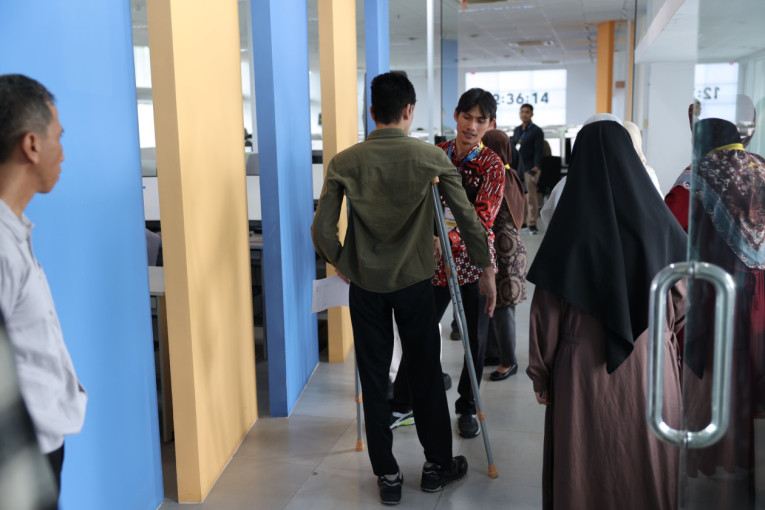
Universitas Gadjah Mada (UGM) is committed to ensuring that the Computer-Based Written Examination for the National Selection Based on Test (UTBK SNBT) 2026 is inclusive for all participants, including 13 participants with disabilities who are taking the exam at UGM from Apr. 21 to 27, 2026.
This commitment is reflected in the provision of services and accommodations tailored to the individual needs of participants with disabilities. From the preparation stage, UGM’s Disability Services Unit (ULD) has been involved in identifying participants’ specific needs. This approach ensures that every form of support provided is aligned with each participant’s condition.
Head of ULD UGM, Dr. Wuri Handayani, explained that her team conducted a needs assessment from the outset using a special form. The form includes personal data, the type of disability, and required accommodations during the UTBK.
Participants were also asked to attach a medical certificate confirming their disability as part of the verification process. This process helps ULD design appropriate forms of support for each participant.
“We want to ensure that every participant receives support suited to their needs, rather than being treated uniformly,” Dr. Handayani said on Tuesday (Apr. 21).
She explained that out of a total of 16 participants with disabilities, 13 completed the needs assessment form, consisting of 12 deaf participants and 1 participant with a physical disability. This data serves as the basis for determining the types of services provided during the UTBK.
This year, UGM is focused on facilitating participation for people with deafness and physical disabilities. Meanwhile, participants with visual impairments are centrally accommodated at Universitas Negeri Yogyakarta (UNY) in accordance with the central committee arrangements.
“Through this assessment, we can better understand each participant’s needs and adjust the services accordingly,” she said.
For deaf participants, UGM pays particular attention to communication needs during the exam. In general, participants can complete the questions independently without special assistance. However, they require sign language interpreters to understand instructions delivered by the committee. In practice, not all participants use sign language, so communication approaches must be flexible.
“Some participants use sign language, while others rely on lip reading, so the approach must be adaptable,” Dr. Handayani explained.
ULD UGM also emphasized the importance of allowing deaf participants to use hearing aids during the exam. These devices are essential to their users and inseparable from them. Therefore, their use cannot be prohibited during the exam. At the same time, potential misuse risks must be anticipated through supervision.
“Asking participants to remove their hearing aids would be equivalent to violating their fundamental rights as persons with disabilities,” she stressed.
As a mitigation measure, ULD had recommended providing a separate room for deaf participants. A dedicated room would support supervision while making it easier to deliver instructions. However, this scheme has not been fully implemented because room arrangements follow the central committee regulations. As a result, supervision of deaf participants is more intensive in regular exam rooms.
“Ideally, they would be in one room so monitoring can be easier without reducing comfort,” she added.
In addition, ULD provided interpreters during the exam. The assistants are present to help convey instructions related to exam procedures. This role is essential to ensure participants do not experience difficulties understanding directions from invigilators. The assistants are not involved in answering the questions, thus maintaining participants’ independence.
“Assistants only help with communication, not with the substance of the exam,” Dr. Handayani explained.
Although the UTBK implementation for visually impaired participants is centralized at UNY, ULD UGM still provided several recommendations to support inclusive exam practices. One recommendation is the use of computers equipped with screen readers and headphones.
In addition, a separate room is necessary so participants can focus without being disturbed by others’ noise. These adjustments are important to ensure visually impaired participants can access the questions optimally.
“Appropriate devices and environments greatly determine the independence of visually impaired participants in completing the exam,” she said.
Furthermore, Dr. Handayani highlighted the importance of adapting question formats for visually impaired participants. Questions based on images or diagrams need to be narrated so they can be accessed through screen readers.
Without such adjustments, participants would struggle to understand the content. In addition, visually impaired participants require at least 30 percent additional time beyond the standard duration.
“They need more time because they cannot read as quickly as other participants,” she noted.
In certain situations, visually impaired participants may also require assistance with the exam process. These assistants are prepared by ULD UGM and have gone through a selection process. Ideally, one participant is accompanied by one assistant to ensure optimal support. This practice has been implemented successfully in previous exams.
“Assistance is provided to ensure participants remain independent while not facing difficulties in understanding exam materials,” Dr. Handayani explained.
The implementation of these inclusive services is governed by several government regulations. One of them is the Minister of Education, Culture, Research, and Technology Regulation No. 48 of 2023 concerning reasonable accommodation for students with disabilities.
In addition, there is the 2017 guideline for disability services in higher education issued by the Ministry of Research, Technology, and Higher Education. These regulations serve as the foundation for policy formulation and service practices at UGM.
“We ensure that every service provided adheres to the principle of reasonable accommodation,” Dr. Handayani stated.
In its implementation, UGM also faces several challenges in realizing an inclusive UTBK, ranging from the limited availability of visually friendly questions to participants who have not openly declared their disability conditions. This situation can affect the accuracy of accommodations provided during the exam.
Nevertheless, UGM continues to improve the quality of inclusive services through evaluations informed by prior experience. The university also ensures that exam locations meet accessibility standards, including entry routes and supporting facilities for participants with disabilities.
“Inclusivity is not merely about ensuring participants can take the exam, but also about making sure they feel safe, respected, and supported from the moment they arrive at the venue,” Dr. Handayani concluded.
Author: Triya Andriyani
Post-editor: Rajendra Arya
Photo: Firsto