


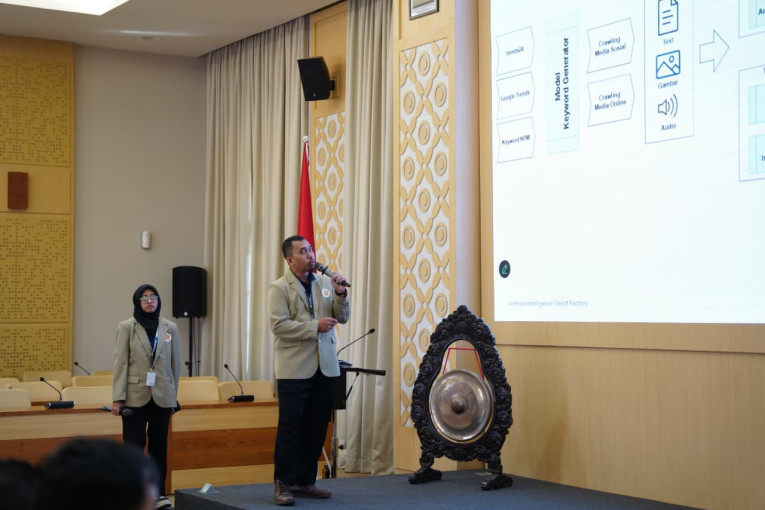
A team of Universitas Gadjah Mada (UGM) students participating in the Artificial Intelligence Talent Factory (AITF) program, facilitated by Indonesia’s Ministry of Communication and Digital Affairs (Komdigi) and UGM, has successfully developed an artificial intelligence (AI)-powered public issue monitoring system.
The application, developed as a use case, is capable of monitoring public issues by crawling news websites and social media, classifying issues and sentiment, analyzing media narratives, and generating daily briefs to support decision-making. The system is designed to collect data from multiple platforms, process text, images, and audio, conduct sentiment analysis, compile issue narratives and daily briefs, and provide a chatbot feature to assist decision-makers.
Gevan, one of the development team members, explained that the project was inspired by growing concerns over the overwhelming volume of content generated in today’s digital economy. The massive scale, diversity, and speed of social media content have made it nearly impossible to monitor, analyze, and develop communication strategies manually.
“This system makes it much easier to monitor public issues, analyze trends, and formulate communication strategies,” he said during the Demo Day and Graduation of the Artificial Intelligence Talent Factory 2026 Batch 1, held at the Multimedia Room, UGM Central Office Building, on Wednesday (Jun. 24).
He further explained that the intelligent monitoring system operates through an integrated workflow that begins by detecting emerging trends using Google Trends and Trends24, while also allowing users to manually input specific keywords based on their needs. The system then employs a keyword generator to expand relevant search terms, enabling the crawling engine to collect multimodal content, including text, images, and audio, from social media platforms and online news outlets.
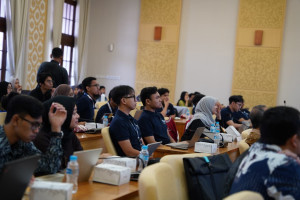
The collected content is subsequently enhanced using AI technologies. Images are processed through image captioning, while audio files are automatically transcribed using speech-to-text technology. The system then automatically labels the data, categorizes sub-issues, and performs sentiment analysis before storing the processed information in a database. The results are visualized via an interactive monitoring dashboard to support timely, informed decision-making.
Through the dashboard, the system also groups articles on similar issues and generates concise summaries that include the essential 5W+1H elements. It identifies key actors involved in each issue and extracts their statements.
“The system can also generate a daily briefing containing viral issues from the previous day, providing authorities with guidance on how to respond,” he said.
In short, the system utilizes AI models to monitor public issues and sentiment in real time while providing an Early Warning System (EWS) whenever an issue goes viral or experiences a significant surge in content volume.
“Using large language models (LLMs), we can map narratives and conversations across digital platforms and formulate proactive communication strategies based on analyses of the latest crawled articles,” he explained.
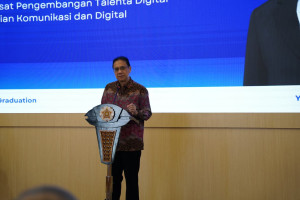
Dr. Said Mirza Pahlevi, M.Eng., Head of the Digital Talent Development Center at the Ministry of Communication and Digital Affairs, expressed his appreciation for the participants’ innovations in his opening remarks. According to him, these innovations were made possible through the AITF program, which has provided students with hands-on practical experience over the past four months. He added that the program represents a collaboration among universities, the government, and industry in responding to the rapid advancement of AI technologies.
“I hope this Demo Day and Graduation serve not only as a showcase of participants’ achievements but also as a constructive forum for discussion. Through the AI solutions presented today, we can better understand how AI can be leveraged to interpret the dynamics of public opinion and support faster, data-driven decision-making,” he concluded.
Author: Leony
Editor: Gusti Grehenson
Post-editor: Zabrina Kumara
Photo: Jesi