



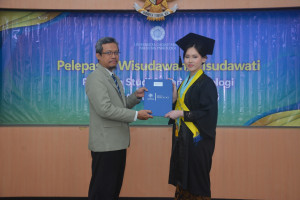
Marlyn Ivana Trigita beamed with joy after successfully completing her undergraduate studies in the Psychology Study Program at the Faculty of Psychology, Universitas Gadjah Mada (Psychology UGM), on Feb. 23. Marlyn was recognized as the fastest graduate, completing her studies in just 3 years, 2 months, and 1 day. The average study period for the 1,201 graduates of the undergraduate program was 4 years and 2 months.
After becoming the fastest graduate, Marlyn said the achievement was the result of persistence and effective learning strategies that accelerated her academic progress without compromising quality. For Marlyn, graduation holds a deeply personal meaning as it represents completing something she had started.
“I began my studies at UGM, so I had to finish them; this graduation marks that completion,” she said on Thursday (Mar. 10).
Marlyn explained that the semester-based course structure in the Psychology program greatly helped her and other students maintain a relatively uniform learning trajectory. Differences in academic dynamics became more noticeable during the sixth and seventh semesters, particularly as students began preparing their theses.
“In psychology, the courses are packaged per semester with a fixed number of credits, so most students follow a similar schedule. The differences usually start appearing around the sixth or seventh semester,” she explained.
According to Marlyn, the main key to completing her studies quickly was focus. She chose to use secondary data that had already been published and validated, allowing her to save time on data collection without reducing the quality of her research.
“The strategy is to focus on your thesis. In my case, the data used were secondary data that had already been published and validated because they were obtained from organizations that had conducted the research,” she said.

She also appreciated the role of her thesis supervisors, who were responsive, efficient, and critical in providing feedback. Their support helped make the thesis-writing process more effective. In addition, the flexibility of her supervisors, the academic staff who clearly explained the administrative procedures, and the support of friends who provided a safe and encouraging environment during the thesis process also contributed to her success.
“My supervisors were quite flexible, very critical, and quick to respond during consultations, which helped a lot. The academic staff in psychology were also very helpful in explaining the thesis process in detail, from submission through to graduation. And I’m grateful to my friends for always supporting me and being a safe space during the thesis-writing period,” Marlyn said.
Despite the smooth process, Marlyn acknowledged that the journey was not without challenges. One of the most complex stages was data cleaning during the thesis-writing process. The dataset she used contained thousands of entries with many variables, making the process of selecting relevant variables both meticulous and time-consuming.
“Data cleaning was one of the most complicated processes during the thesis preparation. The dataset included thousands of records and many variables, so deciding which ones to use took quite a long time,” she explained.
In her thesis titled “The Role of Decision-Making Autonomy in the Risk of Depression Among Married Women in Indonesia,” Marlyn addressed an issue highly relevant to Indonesia’s social context. The research was inspired by Michel Foucault’s ideas on power relations, particularly the notion that the distribution of power does not always operate equally in social practice. In societies that still tend to be patriarchal, power distribution within families is often unequal, especially for women.
On the other hand, in psychology, self-determination theory emphasizes that autonomy is one of three basic needs that play a crucial role in mental health. Marlyn wanted to examine whether patterns found in international studies, where lower levels of women’s autonomy correlate with a higher risk of depression, also occur in Indonesia.
“In Indonesia, there has not yet been research that specifically discusses this issue. That’s why it presents an opportunity to study it,” she said.
The study used secondary data from the fifth wave of the Indonesian Family Life Survey (IFLS), collected by several research institutions. Using this large-scale dataset, she analyzed the relationship between the level of decision-making autonomy among married women and the likelihood of depression.
She also highlighted the phenomenon of shadowed autonomy, a condition in which women appear to be involved in decision-making, but the decisions are not entirely based on their personal preferences. Her observations of family dynamics around her further strengthened her interest in this topic.
For Marlyn, a thesis is a long-term project that must be completed within a relatively short time, especially for students who treat it as their first research experience. Therefore, she emphasized the importance of thoroughly understanding both the research topic and methodology from the beginning.
“Study the topic and methods you plan to use as well as possible. But you don’t have to be the fastest. Just do it as well as you can,” she advised.
Marlyn’s achievement shows that focus, a supportive environment, and the courage to address socially relevant issues can go hand in hand in producing meaningful academic work.
Author: Zabrina Kumara
Editor: Gusti Grehenson
Post-editor: Jasmine Ferdian
Photo: Marlyn’s documentation