


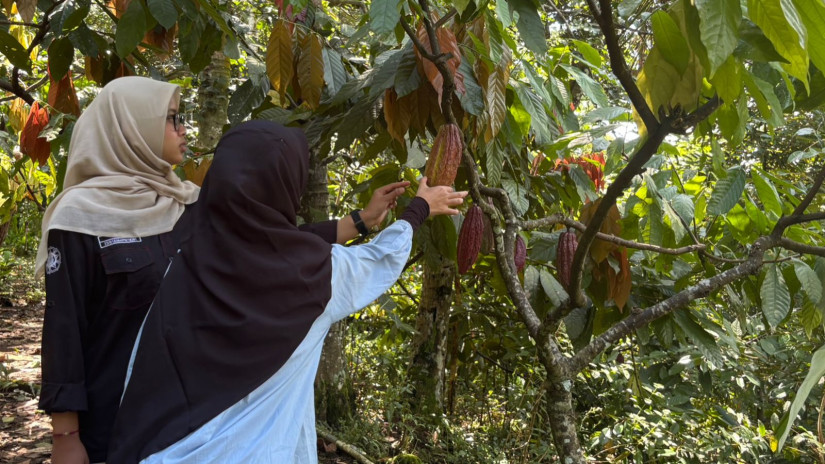
The development of cocoa productivity potential in the Dlingo area of Bantul still faces several challenges, particularly in institutional and marketing aspects. This condition has resulted in suboptimal value-added gains for farmers. In response, students from the Agricultural Extension and Communication Study Program, Faculty of Agriculture, Universitas Gadjah Mada (Agriculture UGM), carried out an assistance program under the Merdeka Belajar Kampus Berdampak (MBKB) scheme.
The activity was conducted in Terong Hamlet and involved local cocoa farmer groups. The program focused on strengthening farmers’ social and organizational capacity as the foundation for sustainable cocoa development.
The assistance program was led by Salma Darajatun as Person in Charge (PIC), along with fellow student team members Azarine Malika Zayyan, Aisya Alifarizki, and Muhammad Rafi Gunadi. The assistance was designed using a participatory approach to ensure farmers’ active involvement in every stage of the process. In addition to improving production, the program targeted the strengthening of farmer group systems.
“We want farmers not only to increase their yields but also to have strong institutions and the ability to make independent decisions,” Salma said on Wednesday (Apr. 22).
In its implementation, the student team partnered with PT Cipta Inovasi Berkelanjutan (Ailesh) as a strategic partner. This collaboration introduced an approach integrating innovation, communication, and sustainability principles. Ailesh supported the assistance process through education and by reinforcing community empowerment practices.
“This synergy enriches the perspectives of both students and farmers in managing cocoa commodities. The collaborative approach is expected to create a sustainable system at the local level,” she explained.
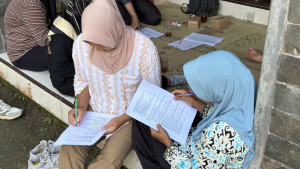
The assistance was carried out through various participatory activities, including Focus Group Discussions (FGDs). Through these forums, farmers, students, and partners discussed challenges and opportunities in cocoa development. This process provided a space to gather aspirations while formulating collective solutions.
Farmers were positioned as the primary actors in the program’s planning and implementation. The discussion results served as the basis for developing strategies to strengthen cocoa institutions and marketing.
From the FGDs, several challenges faced by cocoa farmers in Dlingo were identified. These included pest and plant disease attacks, limited water availability, and unmet needs for quality seedlings. In addition, unorganized marketing systems have kept cocoa prices relatively low. Farmers’ trust in collective marketing systems also needs to be strengthened. These conditions became key considerations in designing the next phase of assistance programs.
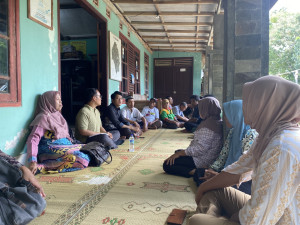
The Head of the Forest Farmer Group (KTH) Jasema, Sugiyono, expressed optimism about cocoa development in the area. He believes that the cocoa potential in Dlingo can still be improved with proper management. Experiences from other regions serve as references for farmers to draw on as they grow. Farmers’ enthusiasm to learn and adapt continues to increase.
“In the future, we hope cocoa production here can reach quintal or even ton-scale yields,” he said.
Meanwhile, a representative from the Agricultural Extension Center (BPP), Rohmat Hidayat, emphasized the importance of improving product quality and marketing systems. He noted that the main issue lies not only in cultivation but also in the product’s market value.
Rohmat stressed that strengthening institutional capacity is key to promoting more effective collective marketing. Support from the BPP is expected to reinforce the ongoing assistance program.
“Moving forward, strong and open institutions must be established so farmers can increase the value of their cocoa,” he explained.
Through this MBKB program, UGM students not only provide initial assistance but also open opportunities for sustained collaboration. The synergy among students, partners, and stakeholders is expected to strengthen local agricultural systems. This program exemplifies the role of higher education in supporting community empowerment based on regional potential.
Strengthening capacity and institutions is a crucial step in enhancing farmers’ competitiveness. With consistent efforts, Dlingo cocoa is expected to become a sustainable, leading commodity.
Reporter: Aisya Alifarizki
Author: Triya Andriyani
Post-editor: Jasmine Ferdian
Photo: Team Documentation