


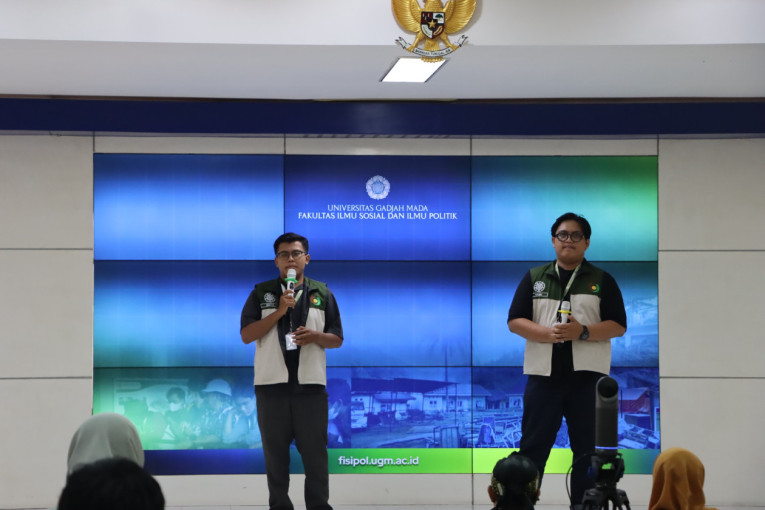
Students from the Faculty of Social and Political Sciences, Universitas Gadjah Mada (Fisipol UGM), held an Exhibition and Dissemination of Volunteer Documentation on Friday (Apr. 24). The event served as a platform to publish the results of community service activities carried out in Aceh and the Nusantara Capital City (IKN). Previously, Fisipol UGM students had implemented several programs, including educational rehabilitation and initiatives in Aceh, as well as waste management efforts in the IKN area. These programs involved Fisipol UGM students as volunteers who directly engaged in fieldwork.
Dean of Fisipol UGM, Dr. Wawan Mas’udi, stated that the deployment of student volunteers stems from efforts to respond to various disaster situations, both those that have already occurred and those that may arise in the future. He cited student involvement in supporting the digitalization of public services and education in post-disaster Aceh, as well as participation in environmental cleanliness issues in IKN.
“Disaster situations and potential disasters require our serious attention. This includes waste, which I consider to have become a disaster in itself and must be addressed seriously,” he said.
He added that the community service program in Aceh was carried out by volunteers from Fisipol Mengajar as part of an initiative to support post-disaster rehabilitation and reconstruction, particularly in the education sector. Meanwhile, activities in IKN were conducted by volunteers from Bala Gadjah Mada, part of the Setrajana Nature and Environmental Enthusiasts Group.
“These volunteers focus more on health, environmental issues, and waste management,” he explained.
Deputy for Development Control at the Nusantara Capital Authority (OIKN), Dr. Thomas Umbu Pati, highlighted various environmental challenges in the development of IKN, particularly related to waste management and deforestation.
“We observe that environmental issues in IKN are still closely linked to waste management problems, deforestation, and illegal mining activities. Therefore, strong governance is needed as regulatory support so that the policies that have been designed can be implemented sustainably,” he explained.
Perspectives on waste management were also shared by the Secretary of the Yogyakarta Waste Bank Association and Vice Chair of the Indonesian Tourism Industry Association (GIPI) DIY, Erwan Widyarto. On this occasion, he emphasized the importance of waste reduction through management based on the 3R principles.
“Waste reduction must begin at the source, one of which is through management based on the principles of reduce, reuse, and recycle so that the impact can be more significant,” he said.
Meanwhile, Chair of the Indonesian Green Youth Coalition (KOPHI) Yogyakarta, Rifka Agnes, highlighted the strategic role of the younger generation in waste management and environmental issues. She also underscored the importance of green open spaces as part of efforts to preserve the environment amid rapid development.
“Young people have a significant role in driving collective movements, both through direct action in the field and digital campaigns that can reach wider audiences and raise public awareness of environmental issues,” she concluded.
Author/Photo: Diyana Khairunnisa
Editor: Gusti Grehenson
Post-editor: Jasmine Ferdian