


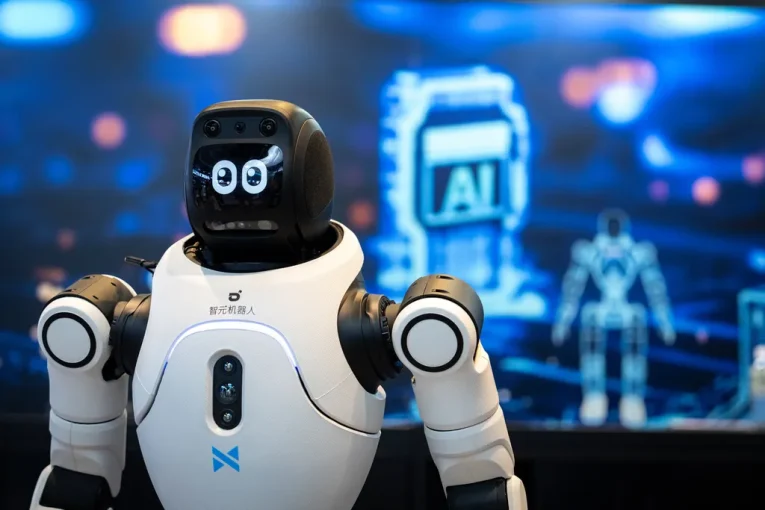
The humanoid robot industry continues to grow rapidly. Today, humanoid robots have demonstrated their ability to walk, move, and even play musical instruments with high precision. Official data show that China had 140 humanoid robot manufacturers and more than 330 models by 2025. In the future, humanoid robots are expected to interact more frequently with humans through emotional exchanges and facial expressions.
Regarding the development of humanoid robot technology, a lecturer at the Department of Mechanical and Industrial Engineering, Faculty of Engineering UGM (FT UGM), Dr. Ardi Wiranata, explained that the advancement of robotic technology is not an instant innovation but rather the result of gradual developments rooted in the most basic technology: machines. According to him, machines are tools used by humans to achieve specific goals, while robots are an advanced form of machines that are automated to perform repetitive tasks on a large scale.
“Machines are tools that help us achieve something. Robots, on the other hand, are automated machines that help us accomplish those tasks in large quantities,” he explained on Wednesday (Apr. 29).
Dr. Wiranata further explained that robots’ potential to reduce human labor depends heavily on the field and industry. He emphasized that robots do not automatically eliminate the role of humans entirely. He also highlighted the current limitations of robotic technology, such as response lag and limited decision-making capabilities.
Robots still require maintenance, repairs, and system adjustments, which in turn create new roles for humans. Therefore, in certain situations, human capabilities remain difficult to replace.
“If there is still lag, the response will not be as fast as humans, and decision-making cannot yet match our speed. In fact, robot production depends on needs, conditions, and industry demands,” he said.
He also noted that the level of technical risk in humanoid robots depends greatly on the quality of sensors and programming systems. Dr. Wiranata emphasized that one of the main challenges in robot development lies in sensor limitations. With an optimal combination of sensors and proper programming, experts can minimize the risk of errors or malfunctions that could potentially endanger humans.
“It depends on the sensors and how the system is programmed. So, it is important to assess whether the sensors used are safe or not,” he explained.
Furthermore, Dr. Wiranata explained that the ability to reduce production costs, as seen in China, is strongly influenced by mass production. With large-scale production, the cost per unit can be lowered, making the technology more affordable without compromising its core functions.
“In China, technology is produced on a massive scale. This mass production can significantly reduce production costs,” he said.
According to him, the role of academics and the younger generation in responding to advancements in robotics is to first understand the systems involved, including how robots work and how they are applied across different sectors.
Dr. Wiranata stressed that not all jobs can be replaced by robots. Some professions still require direct human interaction, especially at more advanced levels where robots cannot easily substitute human roles.
“Most importantly, we must be able to adapt to any form of technology,” he concluded.
Author: Diyana Khairunnisa
Editor: Gusti Grehenson
Post-editor: Jasmine Ferdian
Photo: AP/Chan Long Hei