


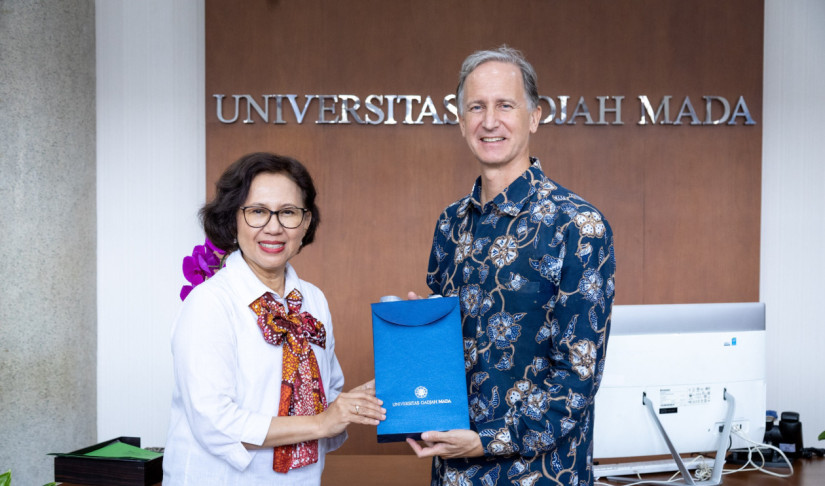
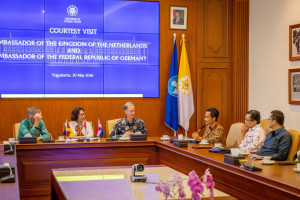
Universitas Gadjah Mada (UGM) welcomed the Ambassador of the Kingdom of the Netherlands to Indonesia and the Ambassador of the Federal Republic of Germany to Indonesia for a courtesy visit on Wednesday, May. 20. at the UGM Central Office Building. The visit marked an important moment in efforts to strengthen cooperation in education, research, innovation, as well as student and academic exchanges between UGM and educational and research institutions in both countries.
UGM Rector, Professor Ova Emilia, warmly welcomed the visit. She noted that there remain many opportunities to expand research collaboration between UGM and institutions in the Netherlands and Germany, particularly through small-scale research funding as an initial step toward building broader partnerships.
“Existing collaborations can continue to be strengthened through further discussions and concrete initiatives in various strategic fields,” she explained.
Ambassador of the Kingdom of the Netherlands to Indonesia, Marc Gerritsen, stated that UGM is one of Indonesia’s most prestigious universities and possesses a strong foundation for expanding academic and scientific cooperation with the Netherlands. According to Gerritsen, UGM demonstrates a dynamic academic environment in which science, the arts, and innovation thrive not only to achieve the highest academic standards but also to generate societal benefits.
“Knowledge should not stop within the campus walls, but should also be introduced and create tangible impacts for society,” he said.
He further explained that the Netherlands collaborates with the Indonesian Endowment Fund for Education (LPDP) in providing scholarships in strategic fields such as horticulture, agriculture, food, water management, and water quality. These areas represent the Netherlands’ key strengths and are considered highly relevant to Indonesia’s development needs.
“We want Indonesian talents to study at universities such as Wageningen University & Research and Delft University of Technology, and then bring that knowledge back to address challenges in Indonesia,” he remarked.
Meanwhile, the Ambassador of the Federal Republic of Germany to Indonesia, Ralf Beste, emphasized that educational cooperation is a crucial foundation for long-term relations between countries. The German Academic Exchange Service program, he said, has become one of the German government’s primary instruments for fostering educational and research ties with Indonesia.
“This program has served as a people-to-people exchange engine for more than a century and has become the foundation of meaningful academic relations,” he stated.
He cited Indonesia’s third president, B. J. Habibie, as an example of how studying in Germany can create a significant impact not only on individuals but also on national development. According to Beste, Germany’s higher education system continues to require fresh energy through student and researcher mobility. Therefore, the German government consistently invests in exchange programs and inter-university cooperation.
“For this reason, we will continue supporting academic and research cooperation with Indonesia, including with UGM, as part of a long-term commitment to the advancement of science and human resource development,” he said.
UGM Vice Rector for Research, Business Development, and Cooperation, Dr. Danang Sri Hadmoko, expressed optimism regarding the continuation of UGM’s partnerships with universities in the Netherlands and Germany, particularly in scientific publications, student mobility, and joint research funding. He explained that UGM has produced more than 600 joint publications with universities in the Netherlands and nearly 500 publications with German universities. According to him, these achievements represent highly valuable academic investments for all parties involved.
“This is a very good investment for UGM and universities in Europe,” he said.
He added that the Netherlands and Germany are among the most popular study destinations for UGM students. Therefore, UGM seeks to encourage more concrete forms of cooperation, including joint funding schemes currently being discussed with German partners.
In addition, UGM continues to expand partnerships with various Dutch institutions, including Wageningen University & Research, and through the Erasmus+ program, which supports student and lecturer mobility.
“Student mobility is very important, alongside the benefits generated through various research projects and professional collaborations,” he stated.
CEO of the UGM Innovation and Creativity Hub (GIK), Alfatika Aunuriella Dini, also highlighted opportunities for collaboration with the Netherlands and Germany through international student internship programs, artist residencies, and the development of innovation ecosystems involving industry and investors.
“GIK is a new creativity and innovation hub established by UGM to connect industries, incubators, accelerators, and venture capital in accelerating the emergence of innovation,” she explained.
According to Dini, this cooperation can be expanded not only in research but also in arts and cultural collaboration. She explained that GIK UGM has an art gallery and an innovation ecosystem that serve as collaborative spaces for students, artists, and industry players from various countries.
“We hope to welcome more international students for internships at one of the largest creativity and innovation hubs in the region,” she said.
Author: Cyntia Noviana
Editor: Gusti Grehenson
Post-editor: Rajendra Arya
Photo: Donnie