


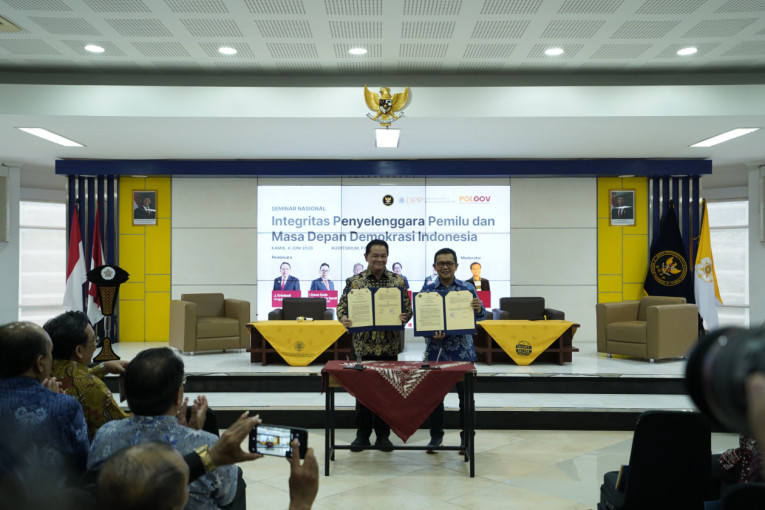
Universitas Gadjah Mada (UGM) and the Election Organizer Ethics Council (DKPP) have formalized a partnership to strengthen democracy and electoral integrity in Indonesia. The Memorandum of Understanding was signed by UGM Vice Rector for Student Affairs, Community Service, and Alumni, Arie Sujito, and DKPP Chairperson, Heddy Lugito. Meanwhile, a Cooperation Agreement on the preparation of the 2026 Electoral Organizer Ethics Index (IKEPP) between the DKPP Secretariat and UGM’s Faculty of Social and Political Sciences (FISIPOL) was signed by DKPP Secretary Syarmadani and FISIPOL Vice Dean for Research, Community Service, Cooperation, and Alumni, Fina Itriyati.
Head of UGM’s Department of Politics and Government, Anak Agung Gde Ngurah Ari Dwipayana, stated that universities have a responsibility to generate ideas, conduct research, and cultivate intellectual leaders through their alumni. According to him, this partnership is not merely about strengthening institutional relations but also a shared effort to bring together knowledge, ethics, and democratic practice.
“Through this partnership, we hope to create broader opportunities for collaboration, including joint research and the development of more inclusive electoral index measurements. We also seek to undertake more serious efforts to strengthen institutional capacity and advance political education and public ethics,” said Ari at the FISIPOL UGM Auditorium on Thursday (June 4).
UGM Vice Rector for Student Affairs, Community Service, and Alumni, Arie Sujito, said that the partnership aims to help ensure the proper implementation of elections. In this regard, universities can contribute strategic input whose purpose extends beyond academic publication to making a tangible contribution to nation-building.
“UGM is committed to helping safeguard the electoral process so that it continues to improve in quality,” said Arie.
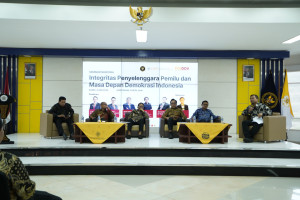
Meanwhile, DKPP Chairperson Heddy Lugito noted that the success of an election should be measured not only by the conduct of the process itself but also by its ability to produce trustworthy leaders. He emphasized that this is a responsibility shared by all members of society, particularly universities, which have a moral obligation to help improve democratic systems.
He expressed hope that scholars and academics would continue to contribute ideas for the future development and improvement of democracy and electoral governance in Indonesia.
“We seek your support so that our democracy can continue to develop and function even better in the future,” he said.
In closing, FISIPOL Vice Dean for Research, Community Service, Cooperation, and Alumni, Fina Itriyati, also welcomed the partnership. She emphasized that academics have an important role in contributing solutions to address the decline of democracy in Indonesia.
“I believe that students, researchers, and activists alike can benefit from this partnership,” said Fina.
Author: Jesi
Editor: Gusti Grehenson
Post-editor: Zabrina Kumara
Photo: Ika