



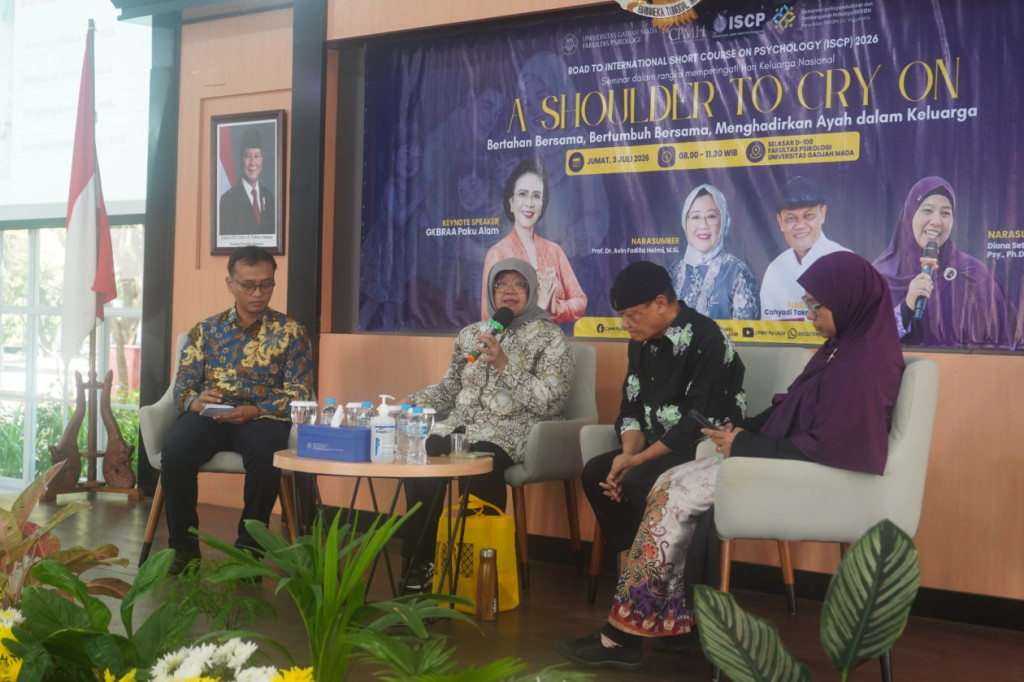
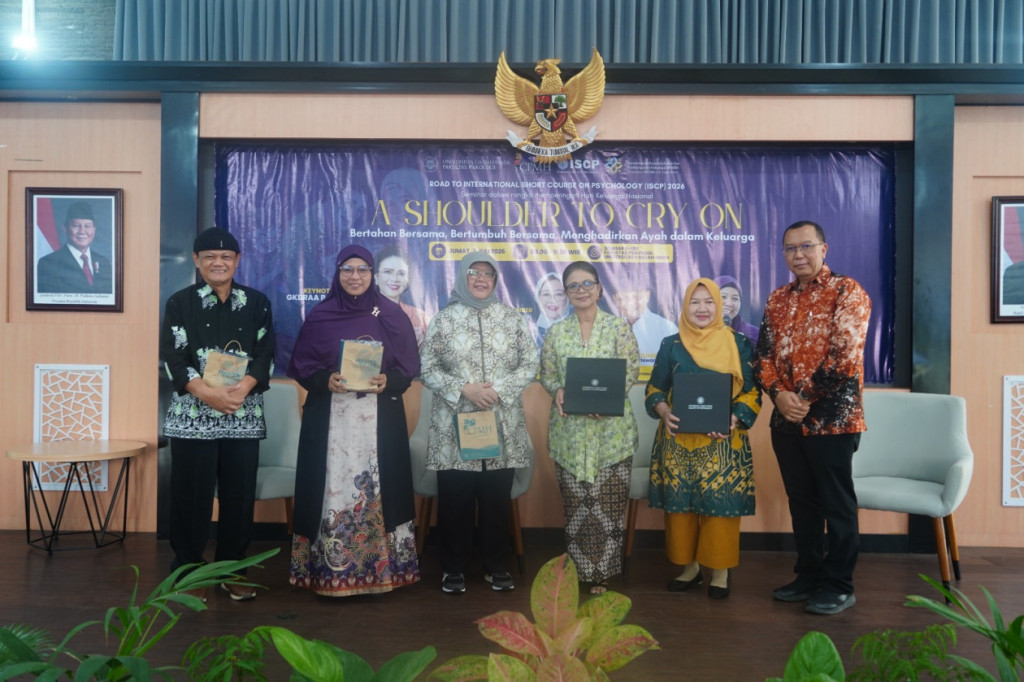
A father’s presence extends beyond providing for the family’s financial needs. It also plays a vital role in shaping children’s character, mental well-being, and resilience in the face of life’s challenges. This message was emphasized during a seminar commemorating Indonesia’s National Family Day, titled “A Shoulder to Cry On: Bertahan Bersama, Bertumbuh Bersama, Menghadirkan Ayah dalam Keluarga” (A Shoulder to Cry On: Standing Together, Growing Together, Bringing Fathers into the Family), held on Friday (Jul. 3) at the Faculty of Psychology, Universitas Gadjah Mada (UGM).
Organized by UGM’s Center for Public Mental Health (CPMH), the seminar featured speakers including Professor Avin Fadilla Helmi, Faculty of Psychology, UGM, and Dr. Diana Setiyawati, a lecturer at the UGM Faculty of Psychology and a licensed psychologist.
In her presentation, Professor Helmi emphasized that fatherhood is not merely a biological status but a conscious choice to be present, protect, and love one’s family wholeheartedly. According to her, a father’s presence significantly contributes to a child’s identity, sense of security, emotional support, role modeling, and the continuity of caregiving.
“Children learn courage, resilience, and how to face the world largely from their fathers. A father’s example is the first lesson children encounter at home,” she said.
However, parenting today has become increasingly complex due to rapid advances in digital technology. Professor Helmi pointed to the phenomenon of alone together, in which family members occupy the same physical space but lose emotional closeness because each is absorbed in their own digital devices.
“We do not lack technology or information; what we lack is attention and emotional connection,” she remarked.
She also highlighted the issue of phubbing, in which parents, particularly fathers, pay more attention to their phones than to their children. Such behavior may leave children feeling neglected and drive them to seek comfort through social media.
“Physical presence alone is not enough if psychological presence is absent. Fathers need to listen to their children’s stories, understand their emotions, respect their opinions, and become a safe person they can turn to with questions. Fathers must serve as a digital compass, providing guidance while teaching essential life values,” she explained.
Conversely, the absence of a father figure can affect boys and girls differently. Boys are more likely to seek role models outside the home, which may leave them vulnerable to negative influences. Girls, meanwhile, may lose their sense of security and experience lower self-esteem.
Professor Helmi therefore encouraged fathers to prioritize quality time with their families through simple activities such as sharing meals, engaging in meaningful conversations, being present during important milestones in their children’s lives, demonstrating responsible technology use, and making it a habit to pray for their children. She also noted that parenting approaches should be adapted to children’s developmental readiness.
“According to the law of readiness, when children are prepared to act and are given the opportunity to do so, they develop a sense of competence. Parents do not always need to be authoritarian; they should also adopt democratic parenting practices,” she said.
Meanwhile, Dr. Setiyawati stressed that strengthening fathers’ roles is not solely the responsibility of individual families but also requires support from public policy. She explained that behavioral change is influenced by the three components of the Theory of Planned Behavior: attitude, subjective norms, and perceived behavioral control.
“It is not only fathers who must be present; the state also has a responsibility to be present. Functional families raise high-quality children, who ultimately become valuable assets for the nation,” she said.
According to Dr. Setiyawati, limited paternal involvement is often influenced by a range of factors, including parental immaturity, economic pressures, mental health issues, childhood trauma, and experiences of emotionally distant parenting.
“Fathers who were never embraced as children often do not know how to embrace their own children when they become fathers,” she explained.
She argued that changing social norms is essential to increasing public acceptance of fathers’ involvement in caregiving. One important step is eliminating the stigma that domestic responsibilities belong exclusively to women.
“There is nothing shameful about fathers doing household chores. On the contrary, this is something we need to continue promoting in everyday life,” she said.
Dr. Setiyawati also proposed three policy pillars that the government should strengthen to better support families: promotion, by improving families’ knowledge and skills; curation, by strengthening family relationships and functions; and prevention, by reinforcing legal systems, expanding social services, and optimizing the use of local resources.
She cited several good practices implemented in Australia, including paid parental leave, fatherhood skills training, involving fathers in maternal and child healthcare services, and father-inclusive family services specifically designed to encourage paternal engagement.
“Policymakers need to develop programs that are more sustainable and have long-term impact. With supportive policies like these, fathers will find it easier to move beyond the role of breadwinner and become active caregivers who contribute to their children’s growth and development,” she concluded.
Through this seminar, Dr. Setiyawati said, UGM encourages all members of society to reconsider the importance of fathers’ presence, not only physically, but also emotionally and psychologically. Strengthening the role of fathers is expected to provide a strong foundation for resilient families and for future generations who are healthy, resilient, and well-prepared to face the challenges of a changing world.
Author: Jelita Agustine
Editor: Gusti Grehenson
Post-editor: Zabrina Kumara
Photo: Firsto and Magnific