


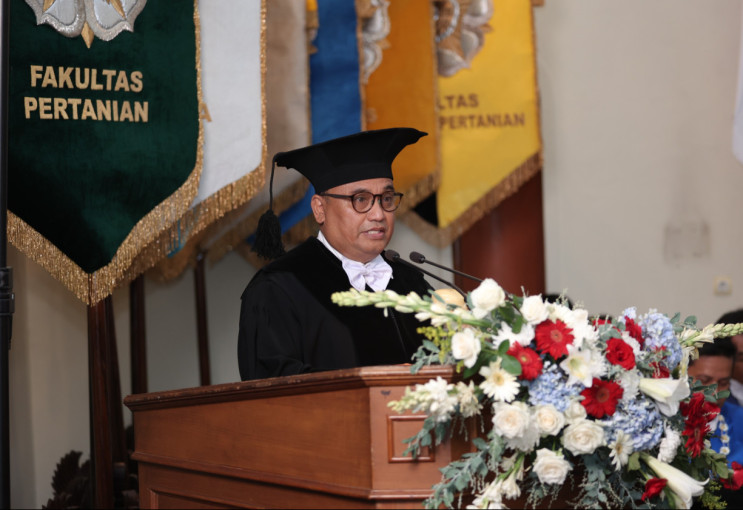
Dean of the Faculty of Agriculture at Universitas Gadjah Mada (Agriculture UGM), Jaka Widada, was inaugurated as a Professor at UGM on Tuesday (Apr. 21) at the Senate Hall. In his inaugural address as Professor in Applied Microbiology, he delivered a speech titled “Holobiont as the Driver of an Applied Microbiology Revolution for Food Security and Global Health”.
Professor Widada stated that efforts to improve the productivity of food crops have tended to focus on variety selection based on growth rate, harvest age, or grain size. However, beneath the soil surface, what happens behind the scenes of such efficiency is often overlooked. In fact, when facing pathogen stress or drought, plants activate complex defense strategies known as the “Cry for Help” mechanism.
“Plants actively excrete up to 30 percent of their photosynthesis products as root exudates. This sugar- and organic acid-rich liquid serves as a chemical signal in the rhizosphere zone,” he said.
According to Professor Widada, the world is currently facing the threat of Microbiome Extinction, or the massive loss of microbial ecosystems due to intensive agricultural practices, excessive use of synthetic fertilizers, and exposure to herbicides. Efforts to restore the soil microbiome through applied microbiology practices are an absolute prerequisite for safeguarding civilization.
“We must shift from merely feeding plants with chemicals to ‘feeding’ the life within the soil. Only from healthy soil can resilient food emerge, and only from resilient food can healthy humans be born,” he explained.
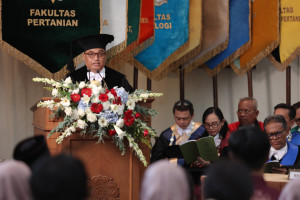
Professor Widada elaborated that such efforts can be pursued through a combination of three revolutionary strategies that integrate natural intelligence with precision technology. One of these is redesigning the future architecture of agriculture to truly harmonize with the intelligence of microbial ecosystems.
“We are moving toward an era where fertilizers come from reactivated biological activity through holobiont-based breeding,” he said.
In an era in which agriculture is managed using precise genomic data, future microbiological interventions will combine advanced molecular biology with intelligent algorithms to create ecosystems resilient to extreme climate change.
“This implementation has demonstrated that high technology through artificial intelligence and genomic engineering helps restore the sophistication of ancient symbiosis that was once lost due to excessive agricultural mechanization,” he remarked.
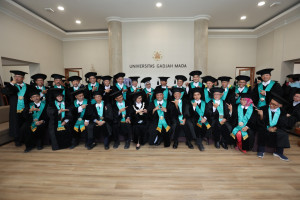
To conclude his speech, Professor Widada presented several visions that he framed as a science-based roadmap to integrate soil, food, and human health into a coherent policy. Several strategic pillars and concrete steps can be taken, including a holobiont-based plant breeding revolution, national microbiome digitalization and AI prediction, implementation of medical agronomy, microbiome health regulations or indices, and local manufacturing sovereignty.
Professor Widada noted that the greatest challenges today include the lack of adequate multi-omics research infrastructure, limited bioinformatics capacity to process microbiome big data, and the insufficient integration of academic research into ecological and industrial policies.
“We must invest more boldly in life science technologies and cultivate a generation of researchers fluent in reading nature’s ‘codes,’ so that our genomic libraries do not merely become untouched treasure troves but engines driving real solutions,” he concluded.
Author: Diyana Khairunnisa
Editor: Gusti Grehenson
Post-editor: Rajendra Arya
Photo: Firsto