


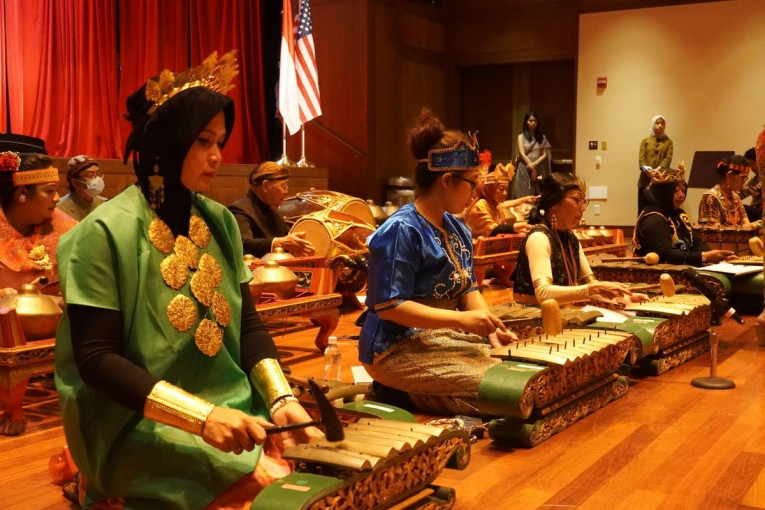
Every April 15 is commemorated as World Art Day, a moment to reflect on the role of art in everyday life. Amid the rapid development of technology and popular culture, traditional arts such as karawitan face challenges in remaining alive and close to society, particularly among younger generations.
A lecturer at the Faculty of Philosophy, Universitas Gadjah Mada (Philosophy UGM), Dr. Sartini, whose expertise is in Nusantara Philosophy, believes that karawitan still holds a strong place, especially in Yogyakarta. However, its sustainability largely depends on how the art is practiced, not merely on its preservation as cultural heritage.
According to her, the advancement of digital technology can, in fact, become a significant opportunity to introduce karawitan more widely. Today, karawitan performances can be easily accessed through platforms such as YouTube or live streaming. In fact, communities abroad are often actively performing karawitan.
“In this digital era, it is actually beneficial for dissemination, even globally,” she said on Tuesday (Apr. 14).
Nevertheless, she observes an irony in the fact that local communities have not fully utilized this opportunity. Many gamelan instruments within communities remain unused due to the lack of performance spaces. As a result, interest in practicing also declines.
“Culture will live if it is frequently performed. But often, it is not presented because there is no space for it to be staged,” she explained.
Even so, Dr. Sartini believes that interest in karawitan still exists. This can be seen in the public’s enthusiasm for participating in festivals or performances. One example is the Karawitan Festival during the anniversary of Philosophy UGM, which has been held for several years and consistently attracts many participants from various groups, ranging from students to community members.
According to her, such festivals serve as evidence that people need a platform for expressing their art. Without such spaces, traditional arts will struggle to develop, even if interest remains.
Beyond entertainment, karawitan also carries deep philosophical values. In a performance, each player has a different role but must listen to one another and collaborate to create harmony. This value is considered relevant to everyday life.
“To produce a beautiful composition, they must nurture one another, communicate, and listen to each other. It reflects human life,” she said.
Regarding younger generations, Dr. Sartini believes that their low level of involvement is not merely due to a lack of interest, but rather limited access and exposure. If they are not introduced to karawitan from an early stage, it is natural for them to choose other, more accessible forms of entertainment.
She also highlighted the strong influence of global popular culture, such as Korean music, which has gained immense popularity through extensive promotion. According to her, this should serve as a lesson that traditional arts also need to be actively introduced in digital spaces.
“If our art is not promoted, it will be overshadowed by others. In fact, if introduced properly, people can also take pride in it,” she said.
Reflecting on World Art Day, Dr. Sartini hopes that karawitan will not only be preserved as a cultural symbol but also continuously enlivened through real practice.
She emphasized the importance of the roles of various stakeholders, from communities and schools to institutions, in providing space for traditional arts to thrive. With such support, karawitan is expected not only to endure but also to adapt to changing times and remain an integral part of modern society.
Author: Zabrina Kumara
Editor: Gusti Grehenson
Post-editor: Jasmine Ferdian
Photo: Courtesy of Kagama Karawitan