


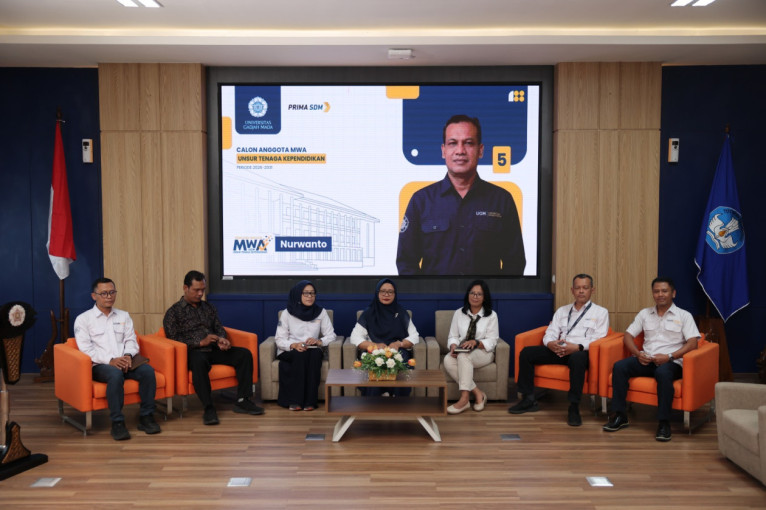
A total of seven prospective candidates for the Universitas Gadjah Mada Board of Trustees (UGM MWA) for the 2026–2031 term, representing university staff, took part in an idea-sharing dialogue held at the auditorium of the Faculty of Philosophy, Universitas Gadjah Mada, on Monday (Apr. 20).
The forum marked the final stage of the selection process, featuring seven candidates and three panelists. It provided an opportunity for candidates to present their programs and respond to questions from the panelists.
Key issues raised included staff welfare, career pathways, and digital transformation within the university.
UGM Vice Rector for Human Resources and Finance, Professor Supriyadi, emphasized that staff representation in the MWA holds a strategic role in shaping university policies. He noted that all staff members have equal rights to elect their representatives.
According to him, this process serves as an important momentum for collectively voicing aspirations. The Vice Rector also encouraged active participation in the election to ensure the best representation.
“We hope those elected will bring forward ideas that truly benefit staff,” he stated.
During the presentation session, candidates highlighted welfare as a primary concern for staff. Nurwanto underscored the importance of financial, social, and academic well-being as the foundation for strengthening the role of administrative personnel. He observed that communication among campus stakeholders still needs improvement to foster greater harmony. In addition, access to self-development information remains uneven.
“We want staff to have room to grow and feel like an integral part of the university,” he said.
Meanwhile, Wisnu Budi stressed the importance of clear career pathways and a more humane work system. He pointed out disparities between performance and career advancement opportunities for staff. He also advocated for needs-based digitalization to ensure systems do not add to administrative burdens.
Furthermore, he emphasized the role of staff in supporting the university’s contributions to society.
“Systems should facilitate work and provide room for growth, not complicate it,” Wisnu explained.
Pentatok Kuncoro Sri Setiyoaji highlighted capacity building through further education and continuous training. He also promoted the creation of a safe, comfortable, and productive work environment. According to him, adequate work facilities directly impact performance. He emphasized that staff play a vital role in supporting the university’s tridharma.
“We want every staff member to be positioned as a strategic asset in university development,” he said.
An innovative idea was presented by Debby Citra Dewi through the ‘UGM TIM’ platform, designed as a digital talent space. The platform aims to connect unit needs with staff competencies across units. She noted that this scheme could enhance exposure, efficiency, and career development. Additionally, it opens broader opportunities for collaboration.
“The potential of staff can be mapped and utilized more optimally through this platform,” she explained.
Nur Bakti Susilo raised the importance of long-term welfare, including post-retirement benefits. He emphasized the need for clear regulations to ensure better access to development opportunities and welfare programs.
He also encouraged asset optimization and the strengthening of data-driven systems. According to him, data-based governance would facilitate evaluation and decision-making processes.
“Policies must be clear and accessible so their benefits can truly be felt,” he stated.
Fitri Yuniarti highlighted the importance of inclusive and sustainable policies. She argued that staff aspirations must be integrated into the university’s policy direction.
Professionalism, she noted, is key to fostering institutional independence. She also emphasized the importance of synergy among campus elements.
“Staff aspirations must become part of policy, not merely be heard,” she said.
Meanwhile, Ika Wulandari Widyaningrum introduced the concept of employee wellbeing as a key driver of productivity. She emphasized that mental and physical well-being directly affect service quality.
A supportive and flexible work environment is considered increasingly necessary. She also recognized the significant potential of digital systems and the younger generation at UGM.
“Wellbeing must be part of a comprehensive performance improvement strategy,” she affirmed.
During the discussion session, the three panelists addressed several strategic issues faced by staff at UGM. Topics included the need for more adaptive work systems to align with workload demands, as well as the challenges faced by female staff in balancing professional and domestic roles.
Attention was also given to the importance of effective mechanisms for gathering staff aspirations across various units and regions. Panelists highlighted the limited authority of MWA members, emphasizing the need for strong communication strategies, data support, and collaboration with internal organizations to advocate for staff interests.
Other issues discussed included transparency in merit-based career pathways, the optimization of digital transformation, and the strengthening of university governance and accountability.
Through this forum, a range of strategic ideas were collected as considerations for selecting staff representatives for the MWA. Issues of welfare, career development, and governance emerged as key priorities reflecting real needs on the ground.
The discussion also underscored the importance of staff roles in university-level policymaking. The event is expected to encourage active participation in the election process.
Author: Triya Andriyani
Post-editor: Jasmine Ferdian
Photo: Firsto