


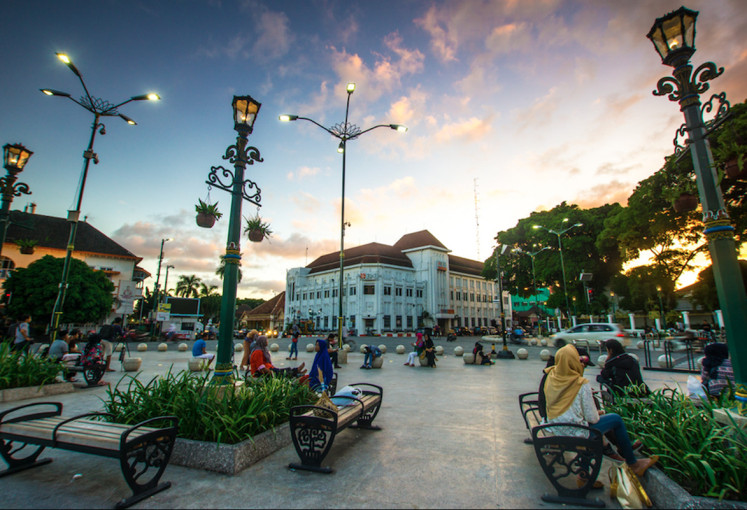
For those who have lived and studied in the Special Region of Yogyakarta, the city undoubtedly holds many memories. Not only the center of education, but also a space where cultural acculturation and assimilation take place, shaping individual character. Every corner holds stories passed down through generations, from a kingdom established through political agreements, to communities living side by side with traditions, and eventually meeting points of diverse identities from across Indonesia. The commemoration of Yogyakarta’s 271st anniversary on March 13 offers an opportunity to retrace this long historical journey. This special city was born out of complex historical dynamics and emerged with the distinctive character that defines Yogyakarta today.
UGM historian Baha’ Uddin explained that the historical roots of Yogyakarta cannot be separated from the political dynamics of the Mataram Kingdom’s final years in the mid-18th century. Political conflict and power struggles within the royal court eventually produced an important agreement that reshaped the political map of Java.
The event, known as the 1755 Giyanti Agreement, officially divided the Mataram Kingdom into two powers: Kasunanan Surakarta and Kasultanan Yogyakarta. From this event emerged Kasultanan Yogyakarta under the leadership of Sultan Hamengkubuwono I.
“Since the 1755 Giyanti Agreement, Sultan Hamengkubuwono obtained domain rights or full authority over the territory of the sultanate. This means that all land within the sultanate was essentially under the authority of the Sultan as a symbol of the sovereignty of an autonomous kingdom,” explained Baha’, Monday (16. Mar).
This concept of land authority later became one of the key foundations of the Kesultanan Yogyakarta governance system. Within the royal framework, land was not only viewed as an economic asset but also as a symbol of political legitimacy and a means of managing community life.
During the colonial period, the land management system in Yogyakarta underwent adjustments. The Kasultanan Yogyakarta government issued several regulations governing the status and use of land within its territory. One of these was the issuance of the Rijksblad in 1918, which distinguished between land under the authority of the Dutch colonial government and that under the sultanate.
The regulation also imposed restrictions on land ownership for non-indigenous groups within the sultanate. In essence, the policy served as a form of protection for local land ownership structures, ensuring they would not be fully controlled by colonial interests. In addition, regulations issued in the following decade regulated various forms of land-use rights for indigenous communities, including andarbeni, which granted ownership rights to residents in urban areas.
Political developments in Yogyakarta did not stop with the division of power between Surakarta and Yogyakarta. In the early 19th century, the territorial authority in Yogyakarta changed again with the establishment of Kadipaten Pakualaman. Since then, Yogyakarta has had two traditional governing entities operating side by side: Kasultanan Yogyakarta and Kadipaten Pakualaman, each with authority over its respective territory.
Despite these political changes, the social and governmental structures in Yogyakarta underwent significant transformation after Indonesia declared its independence in 1945. Yogyakarta officially became part of the Republic of Indonesia while still maintaining certain characteristics that distinguish its governance from other regions.
“After independence, the autonomous territories of kingdoms were abolished to avoid dualism in governance. However, the state still recognized Yogyakarta’s special status through Law No. 3 of 1950, including in matters related to land authority,” Baha’ said.
This recognition positioned Yogyakarta as a region with special status within Indonesia’s constitutional system. In practice, this status also affects land management in Yogyakarta, which differs from that of other regions.
In Yogyakarta, several categories of land have special status: Sultan Ground, Pakualaman Ground, and state land. Sultan Ground and Pakualaman Ground refer to land under the authority of Kasultanan Yogyakarta and Kadipaten Pakualaman.
In everyday practice, communities can still use these lands through various forms of usage rights granted by the palace. These include magersari rights, usually granted to palace servants or residents living near the palace compound; anggaduh rights for managing village areas; and ngindung or nganggo rights, which provide usage rights for individuals or community institutions.
However, these forms of use come with certain limitations because the land legally remains under the sultanate’s authority and cannot be freely traded.
“In essence, the public can use sultanate land with permission from the palace. However, the land cannot be sold, and its use remains under the authority of the sultanate,” he explained.
According to Baha’, this land management system represents a continuation of customary legal practices that have existed since the era of the kingdom. The system is even recognized within the national legal framework through various applicable regulations.
“This is a legacy from the past that continues to be practiced today. We can understand it as a form of customary law recognized by the state within the framework of the Unitary State of the Republic of Indonesia,” he said.
This recognition was further reinforced through Law No. 13 of 2012 on the Special Status of Yogyakarta, which affirms the existence of the sultanate and Pakualaman lands as part of the region’s governance and cultural system.
Beyond political history and land management systems, Yogyakarta also experienced significant social transformation after independence. These changes became particularly visible in the dynamics of society following the establishment of Universitas Gadjah Mada (UGM) in the late 1940s.
Before the university was established, the social structure of Yogyakarta was relatively homogeneous and predominantly composed of Javanese communities. Social life also tended to take place within a relatively uniform cultural sphere, namely Javanese culture.
However, the presence of UGM opened new opportunities for people from different social, cultural, and regional backgrounds to meet in the same city.
“After UGM was established, Yogyakarta’s society, which had previously been relatively homogeneous, became more heterogeneous due to the arrival of students from various regions across Indonesia,” Baha’ said.
The presence of UGM subsequently stimulated the establishment of many other higher education institutions, both public and private. Over time, these developments gradually transformed Yogyakarta into a city of education that not only hosts students from across Indonesia but also serves as a meeting point for diverse ideas, cultures, and social identities.
Within a relatively short period, from the late 1940s to the early 1950s, Yogyakarta developed into a far more open and cosmopolitan city than before. Nevertheless, amid ongoing social changes, the roles of Keraton Yogyakarta and Pakualaman remain essential in preserving the continuity of Javanese culture.
Various traditions, customary ceremonies, and cultural rituals are preserved to this day as part of Yogyakarta’s identity.
“Keraton and Pakualaman are two entities that safeguard and preserve Javanese culture. Traditions and customary ceremonies are still carried out as part of Yogyakarta’s cultural identity,” he said.
Interestingly, the diversity of people coming to Yogyakarta often does not diminish the city’s cultural character. Instead, many people who study and live in Yogyakarta bring the city’s cultural values back to their home regions.
“Many people who study in Yogyakarta actually bring Jogja’s culture back to their regions, rather than the other way around,” Baha’ said.
For Baha’, the commemoration of Yogyakarta’s anniversary should not be interpreted merely as a historical celebration. More than that, it can serve as a moment for the public to reflect on the city’s journey while envisioning its future.
“Even though this is not the anniversary of the regional government, we still need to interpret it more critically. Young people need to participate in public policy by providing constructive input, for example, regarding the use of special autonomy funds so that they truly contribute to public welfare,” he concluded.
Author: Zabrina Kumara
Editor: Gusti Grehenson
Post-editor: Jasmine Ferdian
Photo: Shutterstock