


The Faculty of Veterinary Medicine at Universitas Gadjah Mada (FKH UGM) has deployed 325 student inspectors to examine sacrificial animals and meat during Eid al-Adha across five regencies and municipalities in the Special Region of Yogyakarta (DIY). In addition to the students, the initiative also involves around 200 lecturers and veterinarians. The inspections will take place from Tuesday to Friday, May 26–29, 2026.
Several aspects of animal health, including food safety and the halal status of sacrificial meat, have become major concerns amid the increasing volume of animal slaughter during Eid al-Adha. The situation is particularly critical, as Indonesia remains in the control phase of the Foot-and-Mouth Disease (FMD) and Lumpy Skin Disease (LSD) outbreaks, while vigilance against Anthrax, Tuberculosis, and Peste des Petits Ruminants (PPR) continues to increase.
The deployment and training of the student inspectors were marked by the symbolic presentation of laboratory coats and dissection knives to student representatives, signifying their readiness to work directly in the field. The ceremony was led by UGM Vice Rector for Student Affairs, Community Service, and Alumni, Dr. Arie Sujito, and Vice Dean for Research, Community Service, Cooperation, and Alumni Affairs of FKH UGM, Professor Aris Haryanto, on Saturday (May. 10) at the FKH UGM auditorium.
Dr. Sujito expressed appreciation for FKH UGM’s initiative to deploy student inspectors for sacrificial animals. According to him, activities like this reflect UGM’s commitment to contributing to a theological event that is manifested as a social event, namely the Eid al-Adha sacrifice tradition.
“Activities like this represent UGM’s commitment to ensuring that theological (religious) events can be realized as social events that must be supervised and properly managed,” he said.
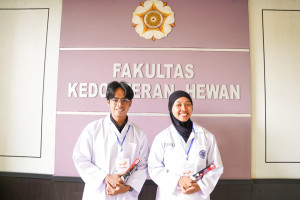
As an educational institution, Dr. Sujito emphasized the importance of sharing knowledge with the public. Through direct engagement with the community, he hopes students can learn to dedicate their knowledge in service to society while creating a learning environment that supports the sustainability of veterinary education at UGM.
“I want this moment to become a learning space for students to practice proper slaughtering techniques, not merely based on instinct but grounded in knowledge, and I believe FKH has that capacity,” he added.
At the end of his remarks, Dr. Sujito emphasized that knowledge holds deeper meaning than mere academic grades. He hopes that practical experience in the community, along with real, practical questions from the public, will stimulate forms of intelligence that students may not develop within the university environment, while also improving their communication skills through community service.
“The knowledge you may not have fully used in classrooms, communities, faculties, or the university can become stimulated after engaging directly with society. Meeting people, hearing their questions, and responding to those questions can sharpen your intelligence. That is what I want to emphasize,” he explained.
Professor Haryanto encouraged students to make the most of this practical opportunity so that the knowledge they gain can be applied optimally in the field later.
The training program was divided into two main sessions: seminars and workshops or hands-on practice in inspecting sacrificial animals and meat. During the seminar session, participants received materials on government policies regarding the slaughter of sacrificial animals amid outbreaks of FMD, LSD, and heightened vigilance against Anthrax and PPR.
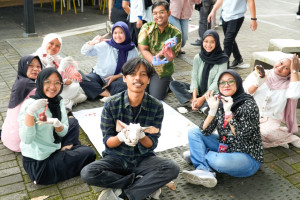
In addition, participants studied the implementation of hygiene and sanitation measures during slaughter in outbreak situations, particularly in DIY areas, as well as policies and waste management practices related to sacrificial animal slaughter. During the workshop session, participants focused on learning antemortem and postmortem inspection procedures for sacrificial animals.
For this training program, FKH UGM collaborated with the DIY Agriculture and Food Security Agency, the Indonesian Veterinary Medical Association (PDHI) DIY Chapter, and the Department of Biological and Veterinary Technology at SV UGM.
The event was also attended by the Head of the DIY Agriculture and Food Security Agency, Aris Eko Nugroho, and the Chair of PDHI DIY, Aniq Syihabuddin.
Author: Zabrina Kumara
Editor: Gusti Grehenson
Post-editor: Jasmine Ferdian
Photo: Aldi Firmansyah