


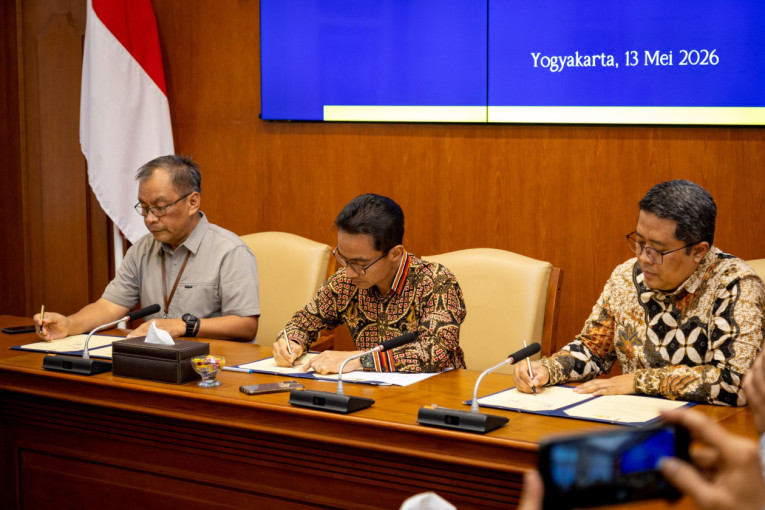
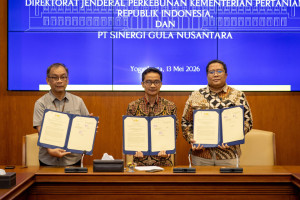
Universitas Gadjah Mada (UGM) has officially established a strategic partnership with the Directorate General of Plantations under Indonesia’s Ministry of Agriculture and PT Sinergi Gula Nusantara (PT SGN). The collaboration focuses on strengthening the university’s tridharma missions while accelerating national food and energy self-sufficiency by optimizing Forest Areas with Special Purposes (KHDTK) as agroforestry-based educational forest areas.
Director of Strategy and Sustainability at PT SGN, Dimas Eko Prasetyo, stated that the synergy is the result of extensive discussions initiated in 2020. He emphasized that the partnership is grounded in mutualism for shared progress.
“We hope this management model can serve as a role model for other regions in supporting food sovereignty, particularly in sugar commodities and energy independence, in line with the direction of the Minister of Agriculture and the President,” he said on Wednesday (May. 13) at the UGM Central Office Building.
Head of the Plantation Crop Protection Center in Pontianak at Indonesia’s Ministry of Agriculture, Gabriel Lulus Puji Hantoro, expressed appreciation and full support for UGM and SGN in accelerating the national sugar self-sufficiency target for 2025-2026. He considered the collaboration crucial to optimizing sugarcane plantations in KHDTK areas through pilot land projects.
“We see this collaboration as a highly valuable opportunity to develop KHDTK sugarcane plantations into a pilot project. We hope this area can become a model that delivers tangible benefits to all parties involved,” he said.
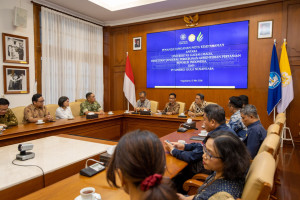
UGM Vice Rector for Research, Business Development, and Cooperation, Dr. Danang Sri Hadmoko, welcomed the partnership as a strategic step by the university to address national challenges. He emphasized that managing the extensive KHDTK land areas is a major challenge that encompasses various fundamental aspects.
“We hope this collaboration becomes a model for KHDTK management that not only focuses on environmental aspects but also creates economic and social impacts. UGM is committed to promoting sustainable and inclusive management,” he stated.
Regarding food and energy security, Dr. Hadmoko stressed the importance of reducing import dependence amid global political uncertainty. He noted that UGM currently has research teams working on biodiesel, bioethanol, and hydrogen energy development.
The initiatives not only examine scientific and technological aspects but also involve 18 faculties and two schools in formulating comprehensive policies that address fiscal and institutional impacts.
“We are ready to collaborate in seeking solutions to the various challenges currently faced by the nation,” he concluded.
Author: Aldi Firmansyah
Editor: Gusti Grehenson
Post-editor: Jasmine Ferdian
Photo: Donnie