


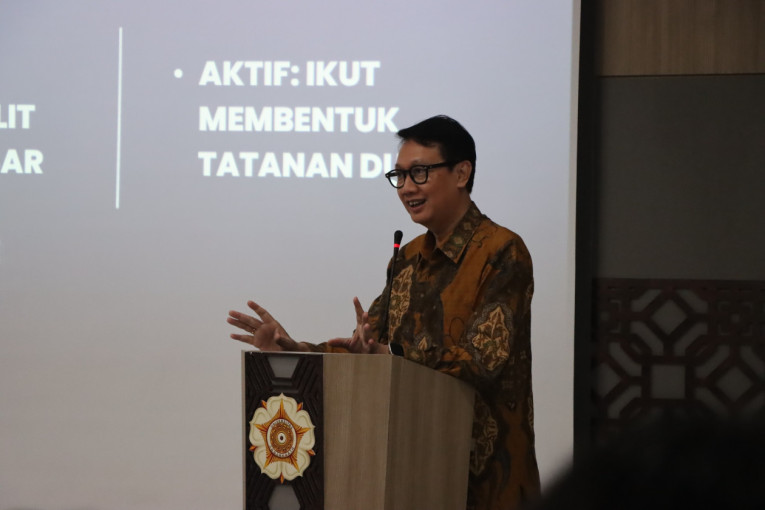
Amid intricate global geopolitical dynamics, Indonesia is considered to have a stronger foreign-policy position. The intricacy is reflected in the growing number of military, technological, and economic conflicts shaping international relations at the recent global level. Vice Minister of Foreign Affairs of the Republic of Indonesia, Arif Havas Oegroseno, stated that global geopolitical patterns have shifted from the Cold War era toward technological and economic competition.
“If ideological rivalry once dominated global competition, today technology, energy, and global supply chains have become new geopolitical concerns. Everything can now become a weapon. Technology becomes a weapon, semiconductors become a weapon, energy becomes a weapon,” said Arif during a public lecture titled “Diplomasi Indonesia dalam Peta Geopolitik Global” (Indonesia’s Diplomacy in the Global Geopolitical Landscape), organized by the Department of Geodetic Engineering, Faculty of Engineering Universitas Gadjah Mada (FT UGM) on Friday (May. 22).
Arif highlighted Indonesia’s strategic position on energy and critical minerals. Indonesia possesses critical minerals such as nickel and bauxite, among others, which have attracted global attention amid the energy transition.
“The government is currently intensifying international cooperation with various countries to strengthen resilience in the field of critical risk,” he said.
Since its independence, Indonesia has consistently pursued a free and active foreign policy, allowing the country to remain independent of any major power bloc. As a result, Indonesia continues to maintain relations with various countries without joining any particular alliance.
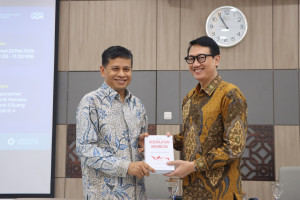
Dean of FT UGM, Professor Selo, emphasized the important role of the younger generation in strengthening Indonesia’s position on the international stage. According to him, university students have significant opportunities to strengthen Indonesia’s diplomatic influence through global experiences such as student exchanges, double-degree programs, and internships abroad.
“Opportunities such as double-degree programs or internships abroad, although they may seem small, can also serve as instruments that shape how Indonesians are perceived overseas,” he said.
Professor Selo also addressed various global geopolitical dynamics, ranging from the Russia-Ukraine war to the wars in Iran. According to him, Indonesia’s position in international relations still needs to be continuously strengthened so that the country’s voice carries greater influence.
“The President has voiced various international issues, but of course, we can evaluate for ourselves how strongly Indonesia’s role is heard globally. Therefore, we need to learn how to build diplomatic strength so that Indonesia is taken more seriously by other nations,” he said.
Writer/Photographer: Hanifah
Editor: Gusti Grehenson
Post-editor: Jasmine Ferdian