


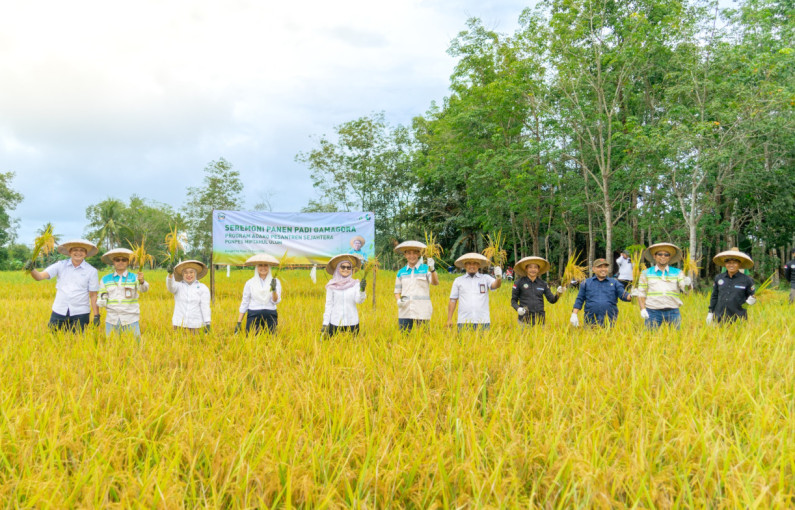
Efforts to strengthen food self-sufficiency continue to be promoted through various innovations in the agricultural sector, including the development of Gamagora rice cultivation based on an educational approach. In addition to focusing on increasing production yields, this approach also incorporates learning processes to build sustainable human resource capacity.
Miftahul Ulum Islamic Boarding School (pesantren) in Bangkiling Raya Village, Banua Lawas Subdistrict, Tabalong Regency, South Kalimantan, recently held a grand harvest of the Gamagora rice variety. This program has successfully engaged the Islamic boarding school community by emphasizing student learning while promoting food self-sufficiency through education.
The Gamagora rice was cultivated on 0.6 hectares of land, yielding a positive result of 2.5 tons of harvested dry grain. The entire cultivation process was carried out in a participatory manner, involving students, alumni, and teachers at every stage. These stages included soil testing, land preparation, technical training, and assistance with pest management and regular crop monitoring.
The chief of Bangkiling Raya Village, Abdul Gafur, stated that the program has had a positive impact on the local community, particularly in supporting food self-sufficiency within the boarding school. He explained that Gamagora seeds have strong potential as a learning medium due to their relatively easy maintenance and resistance to pests. This makes it easier for beginners, including students, to learn agricultural practices directly while gaining skills in farming and agribusiness management.
“In the future, we hope that graduates will be able to become farmers or entrepreneurs, as they have been equipped with education in agriculture and business management in this field,” he said on Tuesday (Apr. 21).
Furthermore, Gafur noted that the boarding school is currently working to foster enthusiasm for agricultural cultivation. He explained that the active involvement of students, alumni, and teachers contributes to the improvement of practical agricultural skills.
“In terms of management, we also involve alumni. Students are usually engaged in agricultural and livestock education activities. During harvest, they can also participate directly in the field,” he said.
He also expressed appreciation for the assistance provided in developing the Gamagora rice cultivation program.
“We are happy and proud to gain knowledge from lecturers who came directly to guide us in developing Gamagora rice. Currently, the program has received strong enthusiasm from our community and the surrounding areas. We are very grateful for the knowledge and support that have been provided,” he concluded.
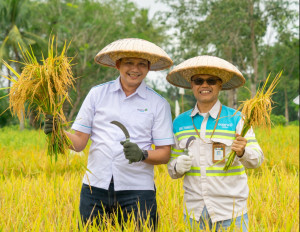
From a development perspective, Professor Taryono, the developer of the Gamagora rice variety, explained that it was designed to enhance productivity while adapting to various environmental conditions. According to him, the land owned by the boarding school has strong potential due to its extensive agricultural area. In addition to serving as a learning facility for students, the land is highly suitable for large-scale food production.
“Based on the crop conditions, the harvest potential is estimated to exceed 8 tons per hectare. This above-average achievement demonstrates that the development of this variety can strengthen food self-sufficiency,” he explained.
Taryono also emphasized that food self-sufficiency is not merely about subsistence farming for personal needs. More than that, it reflects an institution’s or community’s ability to produce food independently, generating economic benefits for surrounding communities.
“The fundamental principle of food self-sufficiency starts from the grassroots level, whether at the household, group, or village level. If a boarding school achieves food self-sufficiency and meets its needs, it can drive its own economic activities,” he said.
Through this education- and collaboration-based approach, the development of Gamagora rice cultivation in Bangkiling Raya Village demonstrates that food self-sufficiency can be realized concretely at the community level. The program is expected to deliver positive production outcomes while building human resource capacity through active involvement at every stage of cultivation.
The Gamagora rice harvest ceremony was attended by PT Adaro Indonesia Operations Director Wahyu Sulistyo, Mining Engineering Head Deny Widihatmoko, External Relations Division Head Rinaldo Kurniawan, HSE Deputy Division Head Didik Triwibowo, Chair of the Amanah Bangun Negeri Foundation (YABN) Zuraida Murdia Hamdie, and YABN Secretary Diah Restu Lestari.
Author: Diyana Khairunnisa
Editor: Gusti Grehenson
Post-editor: Jasmine Ferdian
Photo: Miftahul Ulum Islamic Boarding School Documentation