



A total of 15,789 participants are taking the Computer-Based Written Examination for the National Selection Based on Test (UTBK SNBT) at Universitas Gadjah Mada (UGM).
To ensure the smooth implementation of the computer-based exam from Apr. 21 to 27, the committee has comprehensively prepared information technology (IT) infrastructure, including internet network readiness, computer devices, server systems, and monitoring mechanisms during the exam to prevent cheating. The exam requires high system stability and connectivity across 14 locations spread across faculties and units at UGM. Various anticipatory measures have also been implemented to minimize potential technical disruptions, ensuring that all participants can take the exam smoothly and comfortably.
Director of the UGM Directorate of Information Technology (DTI), Ridi Ferdiana, explained that UGM uses two internet service providers, Telkom and Indosat, to maintain connection reliability during the exam. This dual-ISP scheme keeps connectivity available even if one network is disrupted.
Routine checks of network devices, such as access points and firewalls, are also conducted continuously to maintain system security. This infrastructure is designed to ensure that all exam locations receive stable connectivity.
“We have prepared backup routes so services can continue without disrupting participants during the exam,” he said on Sunday (Apr. 19).
He explained that connectivity between locations is strengthened by a dual-route fiber-optic network connecting the data center to all exam sites. Each faculty and unit has been equipped with high-capacity connections to support data traffic during the exam. Available network speeds range from 1 to 10 Gbps. This infrastructure ensures smooth network access across the 14 exam locations in use.
“With these dual routes, network distribution can remain stable even if a disruption occurs on one side,” he explained.
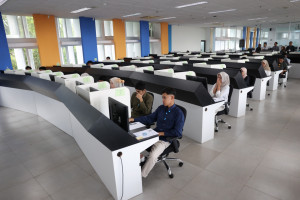
For the 2026 UTBK implementation, a total of 44 exam rooms are being used, supported by 1,452 computer units. This number represents an increase of 80 units compared to the 2025 UTBK, which used 1,372 units. Ferdiana ensured that all computers were prepared with operating systems and software in accordance with national standards.
“We made this addition to ensure capacity remains sufficient in line with this year’s increased needs,” he said.
In terms of systems, UGM operates four server units to support the exam. All servers have undergone load testing and national simulation trials conducted on Apr. 1 and 2, 2026. A monitoring system has also been set up to observe server performance during the exam. In addition, the system is equipped with a failover mechanism so services can continue if one server encounters a disruption.
“If there is a problem with one server, the system immediately switches to another so participants can continue the exam,” Ferdiana said.
To maintain the stability of the UTBK system, UGM follows the national trial series and implementation flow set by the central committee. Testing was conducted in several iterations to ensure all devices function optimally. The committee has also prepared backup computer units to anticipate technical issues in the field. This step is part of efforts to maintain the smooth running of the computer-based exam.
“We ensure every device is truly ready for use, including preparing backups if needed at any time,” said the Professor of Software Engineering.
To anticipate external disruptions, UGM has coordinated with various related parties. The university has coordinated with PLN to ensure a stable electricity supply throughout the UTBK implementation.
Communication with internet service providers has also been maintained to preserve connection quality. These efforts are part of a risk mitigation strategy prepared in advance.
“This coordination is important to ensure all supporting services operate without obstacles during the exam,” he explained.
From a monitoring perspective, UGM conducted a briefing for all UTBK officers on Apr. 16, 2026. This activity covered monitoring strategies and measures to prevent cheating during the exam.
The committee has also identified various patterns of cheating, including those involving both hardware and software. Supervision is carried out comprehensively while adhering to established procedures.
“We equip officers to be alert in recognizing potential cheating and able to respond appropriately in the field,” Ferdiana said.
This year, the UTBK system uses a special Linux-based operating system that runs from USB media. This system is designed within a controlled environment with applications integrated directly into the operating system.
There are no automatic updates or background applications that could potentially disrupt the exam process. Ferdiana emphasized that this system can also prevent the use of remote software often exploited for cheating.
“This closed system environment helps keep the exam process focused and secure from external interference,” he explained.
Ferdiana added that the mechanism for determining exam locations has also been adjusted this year. Participants no longer directly select a UTBK center but only choose an exam location, such as a city. The central committee then randomly assigns UTBK centers, including UGM, UNY, UPN, and ISI Yogyakarta. This policy is implemented to enhance security and reduce the potential for organized cheating.
“With a more controlled placement system, we want to ensure the selection process is fair for all participants,” he concluded.
Author: Triya Andriyani
Post-editor: Rajendra Arya
Photo: Public Relations Documentation